Reading Reflection: Better Off Flipping the Switch on Technology

As an MIT alum, Eric Brende understands how technology can be used on a daily basis in order to influence society and promote efficiency. As a man who went “off the grid” for a year living in a town where the people living in the town would consider the Amish as advanced, Eric Brende discovers how to survive independent of technology often taken for granted. Brende’s novel, Better off Flipping the Switch on Technology, explores now technology can positively and negatively affect an individual’s life.

Experienced vs Inexperienced

When Eric and his wife first move to the “unplugged” town, they are inexperienced in terms of not using technology and going “off the grid”. Their new lifestyle drastically changes how they learn how to perform everyday tasks such as cooking (since they do not own a refrigerator and must learn how to cook food that can be preserved for long amounts of time), obtaining drinkable water/washing dishes/doing laundry (since there is no running water), and farming as a means to earn a living and eat since there isn’t a nearby grocery store nearby. Instead of searching how to do something online and receiving an answer instantaneously, Eric and his wife learn through trial and error and by receiving advice and knowledge from experience of the locals. While performing a task without the use constant use of technology often takes longer and may seem tedious, Brende views these tasks as insightful and rewarding since tasks are now dependent on the human rather than on technology.

Viewpoints on Technology

Throughout the novel, the author describes this certain period in his life as a way for him to step away from the use of technology since he feels as if it is controlling his life. The author generally focuses on the negative aspects of technology rather than the positive. Such negative aspects of technology include: how technology isolates you from every day interaction with people, how you spend so much time with technology it’s almost as if you’re in a daze (driving hours to get to work), and how you become so dependent on technology you never recognize that certain tasks can be done without technology.

While the author constantly explains negative aspects of technology, he rarely focuses on how technology can be beneficial. For instance, with technology, it has become easier to connect with people that you’ve lost communication with faster (ex: Facebook over writing letters). However, messaging a person on social media instead of contacting a person by writing a letter is deemed less personal by society. Additionally, farming (what Brende spent many hours during the day completing while “unplugged”) can be done much more efficiently using technology. By spending less time farming during the day with the use of technology, Brende could have had more leisure time to relax and “have fun”. Throughout the novel, Brende mentions how people can live without luxuries such as heating, indoor plumbing, and electricity but fails to focus on how much easier an individual’s living arrangements becomes with the use of technology. By not having to worry about trivial things such as washing dishes without running water, individuals have more time to complete other tasks rather than attacking tasks that can be completed quicker with the use of technology.

Machines vs Tools

In the community that the author is living in for a year, locals only use the “technology” that was used by people as described in The Bible. They generally refuse to use technology present today. However, why is it acceptable for the people in the community to use the technology from the past rather than the technology of the present? The main distinction between the two was that the technology of the past are considered to be “tools” rather than “machines”. Brende describes the difference by deciding that people dependent on machines, “besides often depriving their uses of skills and physical exercise, they created new and artificial demands – for fuel, space, money and time. These in turn crowded out other important human pursuits, like involvement in family and community, or even the process of thinking itself. The very act of accepting the machine was becoming automatic.” Tools were considered an object that would be used to help perform a certain task whereas machines were objects that were used to perform a task quicker without understanding how to perform the actual task.

Communication Without the Use of Technology

The people in the town the author and his wife live in work as an interdependent community. Overall, people within the community interact with each other in order for all of them to be successful (helping with farming, building, and bringing food to each other). They often use “working” as a time for people to talk to each other about topics ranging from trivial gossip to insightful commentary about personal beliefs. The author uses this time in order to reflect on how the lack of technology affects his performance on everyday tasks and gain experiences from his more knowledgeable neighbors in order to become successful by learning farming and living tricks and cooking tips in order to accomplish tasks quicker or easier.

Relevance to Technology on the Trail

Reading about Eric Brende’s experiences and insights through “flipping the switch on technology” is highly relevant to Technology on the Trail. Not unlike the people from the community that Brende and his wife lived in, many hikers view technology as a taboo concept use excessively. For Technology on the Trail, it is important to research specifically what people determine as useful and unnecessary to bring on the Trail. Additionally, it is important to research and discover how to promote the use of technology on the trail without hindering a hiker’s natural experience on the trail. Not unlike Eric Brende learning how to farm, cook, and live without technology, I am interested in exploring if there is a way for technology to be used in order to share the experiences of a seasoned hiker in order to benefit less-experienced hikers on and off the trail.
Reading Reflection: She Walks These Hills (Today) – Follow Up

She Walks These Hills: Past vs Present

Considering that She Walks These Hills was published in 1994, how would the novel be different if it was written in the present? How would the roles of each character be affected with society’s dependence on technology today? Would the trail be different? How would the local community spread their information?

Where would Hank be Today?

The biggest character difference between (1994 and 2017) would be Hank. In the novel, he is a radio host and was the glue that spread information and invited communication. While the radio is still an important way to spread information, is it still as impactful as it was back then? What other types of technology are able to connect to people today? What is today’s “radio”?

People today are more on-the-go and spend more time on their laptops or their phones. Many people listen to the radio on their commute to work. However, that is becoming less common since the introduction to technology such as Bluetooth in cars. People would rather listen to their own music, free of commercials, instead of listening to the radio. Often, people get their information through news websites, internet blogs, Facebook, etc. Based on the sometimes relevant/mostly irrelevant information that Hank talks about in the novel, from gossip to trying to prove the innocence of an escaped convict, Hank would most likely be an internet blogger. Unlike Radio Hank, Blogger Hank wouldn’t be able to have as much personal contact with his audience. Radio Hank had frequent people calling in to tell him information or discuss a certain topic. In contrast, Blogger Hank wouldn’t have people as many people trying to tell in information immediately. Rather, Hank would merely be writing about a certain topic, allowing viewers to be able to write their own post on their opinions/thoughts. This is drastically different in the sense that not everyone would be receiving the same information since not every single person reading Hank’s blogs would be reading all the comments written by the viewers – including Hank himself.

Where would Jeremy be Today?

Jeremy would still be too unexperienced to be traveling through the Appalachian trail since he still would have been a first-time hiker. However, the items he brings along with him for his journey may be different. Instead of books, Jeremy would probably bring his iPad/laptop which contain the books that he wants for his journey in addition to being able to finding time to write about his journey on his laptop. Since the Jeremy in the novel brought everything imaginable with him on the trail to cover all possible scenarios, he would probably have his phone containing hiking apps and digital maps of the Appalachian Trail. Instead of having to drop all of his items during his trip because of weight, Jeremy would have to leave his items because they got wet from the weather or because he couldn’t find a place to charge his electronics in the case that his portable chargers ran out of battery.

Where would Harm be Today?

Harm’s character wouldn’t be much different than the character he was in the novel. Since he was an escaped convict, he would still have to travel through the Appalachian Trail without supplies, unless he found a way to obtain supplies along his journey. Additionally, since he was serving time for approximately 30 years before he escaped, he would not be as aware of the changes in technology while he was in prison. Harm of the past would still be the same as Harm of the present since he would still be using instinct, knowledge of the land, experience as a hiker, and luck to reach his destination. The only difference with Harm’s journey would be if the Appalachian Trail were to drastically change from his time in prison.

How Would the Town Communicate Today?

In the novel, the community’s main sources of spreading information was through speaking with each other in person, listening to the radio, and occasionally using the landline telephone. Individuals spent more time talking to each other in person and spreading gossip/information. As mentioned in the novel, when trying to research information on Harm, Hank found it more beneficial to obtain information by speaking with people rather than looking at old newspapers/articles.

As a small and close-knit community that was generally technologically unadvanced, communication with others in the town today would still have a focus on face-to-face contact but would also find more time communicating with each other through online medians (text messaging, phone calls, Facebook posts, email, etc.). People would still listen to the radio but they would not be listening or calling in as frequently as they did in the past. The radio would be used more for listening to music, weather/traffic reports, and the occasional gossip rather than the main source of information on important local gossip/news on people/current events surrounding the community. The radio would be used more for impartial, informative, and sometimes entertainment purposes while personal contact or communicating online would be used in order to spread “important” information to each other.

The Trail Today

With people viewing their cell phones as a necessary item, many hikers (day and thru) bring their cell phones with them on the trail. While there are more marked trails than there were in the past, people also use the GPS on their phones to tell them where they are. Additionally, more thru-hikers (hikers that hike the entire Appalachian Trail in one season) are bringing other technology such as laptops or tablets along their journey to blog or as a source of entertainment.

With society today becoming more dependent on technology than they were 10 years ago, the types of items that people deem “unnecessary” have also changed. While a solar shower can still be determined as superfluous on the trail, many hikers have changed their opinions on bringing a cell phone on the trail. Today, the cell phone can be used simply for calling family members to ensure them that they are safe, finding upcoming rest areas, determining how much further away a hiker is from a certain destination, or even for ordering pizza. The most important thing to consider now that technology on the trail has become more frequent in recent years is to determine and decide what is unnecessary on the trail and what can be considered as beneficial for a hiker (novice and experienced).

Workshop Wrapup: Used, Amused, and Confused

One the second day of TotT’s workshop, which brought together interested academics and students of different backgrounds to discuss tech on the trail research, I (Gracie) had an opportunity to present to everyone my ongoing thesis work. The spotlight was particularly unnerving since the returned data from the several completed probes had only just come in, so I hadn’t had a chance to do a deep dive analysis yet. Even so, both polishing a presentation and having discussions about my probes were a good way to start off my data analysis for my thesis.

As a reminder, the basic gist of my probe can be read here; this post will be long enough without rehashing all that.

To start broadly, the most challenging question I received from the audience while presenting boiled down to, “Why? What’s the point of this?” The other day, I attended my friend’s dissertation defense about using big data sets in introductory CS education, and he received a similar question from the audience. In his case, the room was discussing the limitations of CS education research in regards to having no experimental control group and being rife with other uncontrollable variables, and someone finally asked, “Why should we believe any of these results?” For my friend’s research, I think having a good course outcome for students is a valuable goal in and of itself, but it seems to me that the qualitative side of HCI (and of social research in general) is often criticized as being pointless or inconclusive. In my case, even if I can draw solid conclusions about how hikers feel about technology on the trail… so what? How does that help anyone?

When I was designing my study, it would’ve been easy to craft a list of specific questions to ask participants. Do you ever bring a smartphone on a hike, yes or no? Do you feel like people are overly dependent on GPS, yes or no? The thing about asking specific questions is that you get limited and often expected answers. Questions can be more open-ended, and they could be posed in an interview that allows some back and forth, but the problem is still that I’m creating these questions that are limiting the answers I get. How do I know what questions to ask? Before joining TotT, I never knew trial angels existed for thru hikers, so I wouldn’t have known to ask any questions in that vein. I don’t doubt there’s a wealth of other trail and hiking related knowledge that I haven’t been exposed to yet.

So how would cultural probes fix that? I’d never heard of a research method in this vein before coming to grad school here. (In fact, I hadn’t even really heard of Human-Computer Interaction despite doing Computer Science and Interactive Media in undergrad, but that’s a different discussion.) In my Models and Theories of HCI class, we spent a day talking about cultural probes as a way to creatively draw out a response to a particular prompt or idea. I loved the idea as soon as I read about it. Personally, I’m bad at speaking unprepared; I’m fine if I have a script or thought about it in advance, but for something like an interview, it’s difficult for me to shape a response with any depth on the spot. Even taking written surveys can produce the same problem as I continue to think of more things relevant to the survey questions long after taking them. Having a probe stay with me over a period of time as I continue to shape my answer solves those issues, as well as a few others.

A cultural probe can be shaped for its audience. And it can hit a wider audience with the flexible nature of the responses. Prefer to respond in writing? Go ahead. Prefer to record a video? Have at it. This is demonstrated well in my scrapbook responses, where one participant filled the pages with writing, and another pasted only photographs. Probes allow the questions to be fuzzier as well. One of the scrapbook pages is themed “Proof you were there,” which doesn’t suggest what form proof needs to take. The way that participants interpret and answer the questions will say a lot about what’s most salient to them regarding tech and the trail.

It also offers a lot more room for creativity, which is something I’m passionate about. There was a good example of this at the workshop as well. After my presentation, I divided the attendees into three smaller groups to have a hands-on look at my early data results. One group was given the responses for the Indoor Hike (2) and the Hike Club (1). Whenever I passed by, I heard this group discussing one particularly well written Indoor Hike response, and by the end, they were happy to share with me another odd Indoor experience: have someone act like a trial guide to a group, but have it be inside a mall, so they’re giving their group a running dialogue of the environment and flora/fauna of the mall. They suggested a few phrases that might be passed around and had a good laugh. Later, one of the participants and I were chatting, and the Nacirema article which really captures the idea of taking something familiar and making it “strange.” That was one of the main driving themes behind the Indoor Hike activity, so it was gratifying to hear it discussed.

So, what do I hope to get out of these probes? A lot of unique perspectives that I wouldn’t be able to get by just talking with someone. I want a broad range of thoughts and opinions. I want a better look at the diversity that exists in hiking and outdoor communities. And that knowledge should be fueling tech on the trail discussion, making our conversations more nuanced and our views more accurate. I don’t want anyone’s voice to get lost just because they didn’t thru hike the entire Appalachian Trail. And really, there’s no point in designing technology if we don’t even know who we’re designing for or what need we’re filling.

Workshop Wrapup: Technology on the Trail Day 2

The second day of the Technology on the Trail workshop at Virginia Tech consisted of a pair of work sessions and a workshop wrapup.

The first work session, led by Nicholas Polys and featuring John Munsell and John Jelesko, looked at science on the trail. It delved into the challenges of taking technology outdoors, balanced with the opportunities that it provides. Of particular concern are problems of cleaning up “dirty data” from erroneous readings. It’s great to get more people involved in data collection, but without knowledge, training, and high-quality equipment, we run the risk of collecting erroneous data.

The second work session, led by the project research associate Grace Fields, focused on her cultural probes. We got to try out some of her “would you rather” probe questions, e.g., would you rather hike on a rainy 60 degree day or a sunny 30 degree day. It was noted that these aren’t opposites (they aren’t meant to be!) and often the answer is “both”. Other probes and, importantly, some early probe results were presented. The results really drove some interesting conversations, and also highlighted the need for follow-up interviews or focus groups to delve deeper into the “why” behind the responses. Alan Dix noted that probes are better at putting forth questions rather than answering them, making it important to discover the key questions that emerge from looking at the probes.

The wrapup sought to both look back as well as look forward. There were great ideas shared about possible partnerships, follow-up events, opportunities for funding, and venues for writing. At this stage of the initiative, it is important to cast a wide net and to work in directions that meet real needs for people and organizations that care about trails and that see value in technology. All are encouraged to share ideas and help out!

2017-03-04 10.03.37.jpg
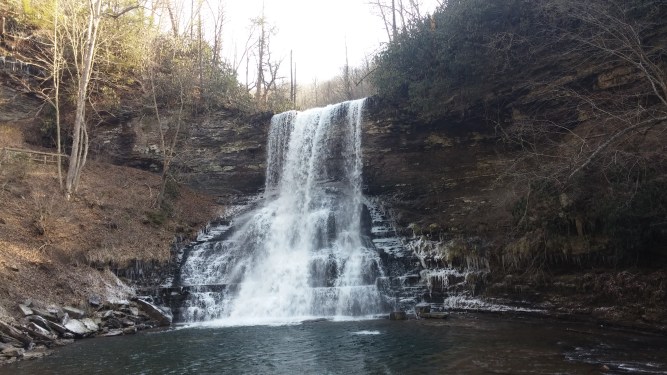
The Cascades (a bit frosty around the edges)
2017-03-04-10-17-17
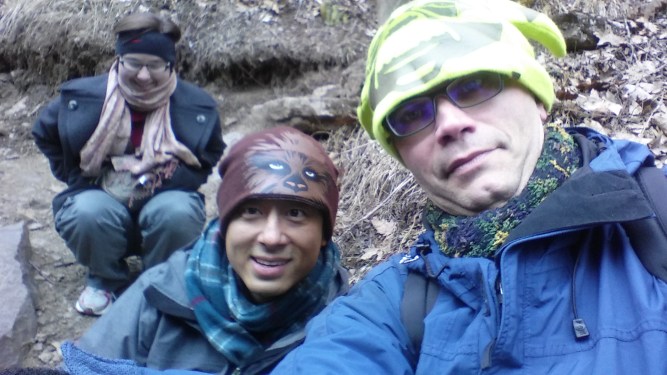
Chewbacca (Norm) and Yoda (Scott) staying warm
2017-03-04 10.06.56.jpg
Steve Harrison offering date and fig cake to Alan Dix and the masses

As a quick addendum and final photos: Day 3 saw us match our efforts to our talk, as we hit the trail for a hike to the Cascades. Ten of us made the 4-mile walk in below freezing temperatures to view the iconic waterfall and continue our conversations.