Grace Fields thesis recap: Using Cultural Probes to Understand Hikers

Grace Fields, our grad assistant who spearheaded the early Technology on the Trail initiative—most notably the workshop—successfully defended her Master’s thesis on August 21, 2017!  Her thesis was titled “Technology on the Trail: Using Cultural Probes to Understand Hikers”.  Steve Harrison served as chair, and Aisling Kelliher and I were the other committee members.

Gracie employed a cultural probe method toward seeking to understand how hikers collect and share their experiences on the trail.  Bill Gaver and his colleagues introduced the notion of a cultural probe as a way to encourage participants to think in an open-ended, creative manner about their experiences.  Rather than giving them nicely printed questions on a sheet of paper, a cultural probe provides them with things like photo albums, a media diary, maps, a camera, and similar artifacts that are then paired with non-traditional prompts that encourage creative reflection.  Results of a cultural probe then can Cultural probes are not meant to yield repeatable, scientifically-grounded findings, but rather to uncover unique perspectives about the way that

Gracie crafted probes that challenged her participants to reflect on or re-imagine their hiking experiences using several prompts (see the picture at the bottom of this post).  Some of her probe prompts include “would you rather” questions that ask participants to choose between two options (e.g., would you rather have a photo you took go viral, or have a photo with you in it go viral), inventing activities for a reflective hike club (with membership size, activities, outcomes), and creating themed scrapbook pages (e.g., people you miss when on long hikes, telling your hiking story).  We learned a lot from the cultural probe, perhaps most importantly about how to run a cultural probe!

Gracie’s cultural probes probed a handful of people that she (or I) knew well, who were willing to take part in the probe activities with minimal compensation.  The results were sufficiently promising that we are seeking funding for a larger-scale investigation, seeking to understand the breadth of people on the trail and the many motivations that they have for their trail activities.  We expect that, by showcasing Gracie’s early results and providing monetary compensation, we will be able to create a rich and diverse picture that reflects current and desired ways that people reflect about trails.

Gracie’s thesis is now available online, and a fellow student, Navya Kondur, crafted her own investigation and analysis focused on one aspect of Gracie’s cultural probes.

Screenshot-2018-12-18-14.53.44.png
Sample materials included in Gracie’s probe kits (detailed from Gracie’s thesis document)

ICAT Day 2017 project recap

The Institute for Creativity, Arts, and Technology (ICAT) holds its annual ICAT Day every May, and this year’s theme was Sensing Place; apropos to the geo-sensing aspects of our initiative.  We set up a series of projects related to Technology on the Trail, largely drawn from our CS 6724 graduate special topics class.  Here’s a recap of them, along with links to ongoing work and press releases.

Andrey Esakia presented FitAware, his extension to the FitEx health and fitness program. FitEx leverages relationships within and between teams to improve physical activity behaviors, and FitAware helps raise awareness of individual and team fitness behaviors through smartwatch and mobile device interfaces. FitAware was a featured story in Virginia Tech News, and he authored a work-in-progress paper that appeared at the ACM SIGCHI Conference in May.  Andrey was funded by ICAT this past year, in collaboration with Mike Horning, Samantha Harden, and Scott McCrickard.

2017-03-02 18.16.09
Shuo and blog author Alan Dix interacting with his data on the Microsoft Perspective Pixel and a secondary cloud display

Shuo Niu demoed his collaborative surface system for exploring hiking blog data. He uses a 55-inch multitouch tabletop display to show various analytics-based visualizations of the contents of hiking blogs. Words and phrases from the blogs can be manipulated to reveal repeated themes within a blog–often themes that the blog authors themselves didn’t realize were part of their blogs! A paper about this work is under review to appear at the ACM GROUP Conference (available upon request).

2017-05-01 15.29.12
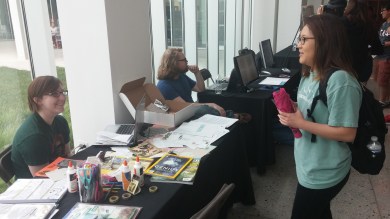
Gracie exhibiting her cultural probe materials at ICAT Day

Gracie Fields displayed results from her cultural probes, a technique she employed to understand how people prepare for, undertake, and reflect on hiking experiences. Probes were sent to hikers of varying ages and abilities, from a 13-year-old Boy Scout who has done a few extended hikes to people in their 60s who have spent weeks at a time hiking. The probes asked people to answer questions, undertake preparatory hiking activities, reflect on personal and themed pictures, and much more over a multi-week session, toward encouraging participants to think and reflect in multiple ways about what hikes mean to them. Navya Kondor and Jagath Iyer also presented a spinoff presentation focused on the “would you rather” questions. More about Gracie’s work can be found in her recently completed thesis (available on request).

Tim Stelter presented a reflection on his week on the Appalachian Trail. I gave my class the challenge that if they took technology onto the trail for a 100-mile hike, it would earn them an automatic “A”. He and his dad covered over 50 miles (so 100 miles combined?) over spring break, and Tim generated a reflection paper to appear in the NatureCHI workshop in September. An article about his preparation for the hike appeared in our local Roanoke Times newspaper.

2017-05-01-15-29-25-e1500496102840.jpg
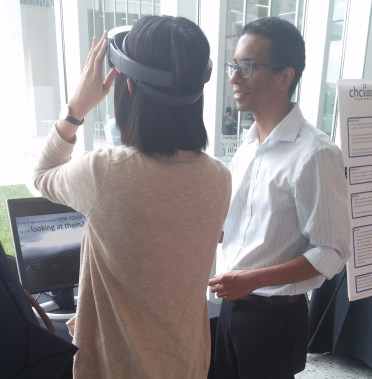
An ICAT Day attendee trying out Wallace’s Microsoft Hololens waypoint identification system

Some quick notes about other projects related to the theme. Colin Shea-Blymyer investigated mindfulness and forest bathing using EEG devices that monitored brain waves. He looked at baseline data from indoor EEG use, then compared it to data collected on outdoor hikes. Abigail Bartolome is collecting Twitter data from the three “triple crown of hiking” trails in the US: the Appalachian Trail, the Pacific Crest Trail, and the Continental Divide Trail. Her focus in Spring 2017 looked at the different emotional themes that emerged on each trail. Phillip Summers crafted visualizations of hiking data that was uploaded to a public repository, particularly the geo-temporal data. He was able to identify main trails, side trails, camping areas, common turnaround points, and more. And Wallace Lages used the Microsoft Hololens to craft an augmented reality waypoint identification system for hikers.

Most of these project are still under way, so comments below or via email would be greatly appreciated!


Projects: Technology on the Trail Class Projects Spring 2017

The Spring 2017 school term provided the opportunity for senior grad students across multiple disciplines to help shape Virginia Tech’s approach to the study of technology on the trail. This group had the added motivation that they had the opportunity to interact with attendees at the Technology on the Trail Workshop at Virginia Tech, including invited guests Alan Dix, Allison Druin, Ellie Harmon, and Norman Su. Below is a summary of the projects that they undertook.

NOTE: most of the students continued their work on the projects, and many resulted in papers, theses, and dissertations. This post has been and will continue to be updated with links to new papers.

  • Identities and Values Reflected in Tweets Regarding America’s Triple Crown Hiking Trails. Master’s student Abigail Bartolome applied topic analysis to collections of tweets pertaining to three distinct American trails–the Appalachian Trail (AT), the Pacific Crest Trail (PCT), and the Continental Divide Trail (CDT) to see differences in topic models across the three hiking communities. This research compared the most popular topics from each community with their respective mission statements and values. Abigail featured this work in her M.S. thesis, advised by Edward Fox with committee members Scott McCrickard and Jeff Marion. Abigail is now working on a Ph.D. at Dartmouth University.
  • Would you rather – Probing Tradeoffs with Technology in Hiking and Outdoors Settings Identities and Values Reflected in Tweets Regarding America’s Triple Crown Hiking Trails. Grad students Navya Kondur and Jagath Iyer collected opinions through a “Would you Rather” cultural probe to understand perceptions of humans toward technology in hiking and outdoor settings. This work was continued by Navya toward her M.S. thesis.
  • Augmented Reality for Outdoor Navigation. Wallace Lages investigated how augmented reality can be used to support the creation of new routes on the trail, crafting the design, implementation, and early evaluation of a system for defining waypoints using the Microsoft Hololens. This research describes and compares two techniques for marking, one based on triangulation and another based on perceptual depth judgment. Initial evaluation shows that both techniques offer similar accuracy in long distances and small baselines, and that triangulation can be better for wide baselines. Wallace completed his Ph.D. at Virginia Tech and has taken a faculty position in Virginia Tech’s School of Visual Arts.
  • AwareSpace: Supporting Co-located Document Exploration with Touch, Text-mining and Visualization. Shuo Niu used surface technologies, a tabletop computer, and a vertical large display to support dynamic explorations of textual data—with a focus on social media data like blogs and tweets. The displays highlight hints on possible knowledge of interest, often surprising the authors of the blog. Shuo featured the tool at the Technology on the Trail workshop, surprising workshop invited guests Alan Dix and Ellie Harmon with insights about their own blogs. Shuo featured this work in his Ph.D., which he completed in 2019. Shuo is now an Assistant Professor at Clark University.
  • Zen and the Art of Forest Bathing. Colin Shea-Blymeyer sought to determine if mindful hikers get more out of hiking, and to develop an application to promote mindfulness on the trail. He catalogued a personal experience that demonstrated the scientific and emotional possibilities for this line of research. Colin completed his M.S. degree from Virginia Tech with Ben Jantzen in philosophy.
  • Hiking the Appalachian Trail with Technology. Tim Stelter was my only student who took me up on the challenge to hike 100 miles noting tech experiences along the way for an automatic “A” in the class. (I was joking, but I assumed anyone who did this would earn that grade.) Tim accrued over a dozen different pieces of technology and recruited his father to go with him on a portion of the Appalachian Trail. He took notes and made audio recordings along the way. His attempt attracted the attention of the Roanoke Times, which featured a story about his journey, along with other parts of our workshop. Tim submitted a diary-style writeup for the course. Since the course ended, he has generated 3 position papers at workshops based on his hike, and he is looking to incorporate the lessons learned from the hike into a thesis or dissertation.
  • Modeling Hiking Trails in 3D using GPS Tracks. Phillip Summers crafted visualizations of hiking trails in a 3D interactive environment using geographic information from users traveling the Tour du Mont Blanc who uploaded their data to Wikiloc. The project cleaned raw GPS data, aggregated points on a continuous space disconnected from streets and waypoints. Mont Blanc was chosen because, at the time, it was known for many people uploading GPS data for public use.

Reading Reflection: Tim Ingold’s Lines

At our Technology on the Trail workshop in March, invited speaker Alan Dix highly recommended a book by Tim Ingold titled Lines: A Brief History. We purchased it and made it available to people taking part in the initiative, with some thoughts listed here.

From Alan Dix’s blog post referencing Lines: “Ingold’s thesis is that we have privileged the point or place in modern thought, seeing the connection as merely the means of getting from A to B. Ingold is an anthropologist and spent time studying reindeer herders. Their way of life is to follow the herds as they make seasonal migrations; for the tribes following the herds it is the way they follow, the path, the line, which is primary.”

Ingold’s book explores how lines are a key part of walking, writing, storytelling, and much more.  The book probes the foundational meaning of a line, and what it is and means across various domains, noting early on that “to an illiterate reader, lines have no more meaning than abstract art”. There are tons of other examples in computing in HCI, e.g., certainly those who study visualization have a skill in recognizing patterns that an unskilled eye could not pick out.

The book is highly speculative, putting forth a series of analyses of topics and situations that were often not well grounded in evidence, which some found unsatisfying. Grad seminar participant Colin Shea-Blymer summed up this viewpoint very well:

I honestly appreciate the book’s magnificent scope, and, when taken as more of an artistic endeavor, it succeeds in that scope in many ways. However, coming into the book from a more critical perspective I found Ingold’s introductory apology for his lack of depth in many of the subjects he tied lines to unsatisfactory. The sections of his book that I muddled through read more like a stringing-together of romantic-era aesthetic arguments as evidence towards an unstated hypothesis; done without criticism of the arguments he appropriates. In brief, the book works well if you’re looking for an eye-opening overview of how lines go undetected in human art and society, but falters if the reader begins to scrutinize the arguments within. The path Ingold illuminates is beautiful and worth peering down, but the steps he takes appear treacherous and unstable upon closer inspection.

There’s more Ingold work, including another book that seems like it might be even more relevant to our Technology on the Trail theme, an edited collection titled Ways of Walking: Ethnographies and Practice on Foot (also available in the Virginia Tech library), stemming from a meeting of anthropologists who split time “sitting in a traditional seminar room” and “climb[ing] up through the forest and out to the open hillside”.  Given the similarity to our own seminar, there may be a review of this book in the near future!