Workshop Wrapup: Technology on the Trail Day 1

Today we kicked off the Technology on the Trail workshop at Virginia Tech.

The morning started with talks by our four invited guests: Allison Druin from the National Park Service, Alan Dix from Birmingham University (UK), Ellie Harmon from Encountering Tech, and Norman Su of Indiana University. The talks were very different, but all touched on the self-discovery that takes place when people go out on trails, and the evolving and sometimes contentious role that technology has with it.

2017-03-02-14-56-04
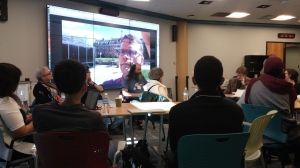
Scott McCrickard’s giant selfie looms over Alan Dix during a discussion of the phenomenology of selfies.

The afternoon consisted of work sessions, when we delved into topics of interest. Steve Harrison led the first session, titled “Spectacle vs Experience”. Groups talked about the nature and phenomenology of the selfie, the mediation that takes place in technology on the trail, and the roles taken on in traversing trails. Michael Horning led the second session. It focused on seamfulness in nature, looking at different types (and subtypes) of trail users that exist. For example, hikers’ goals on the trail differ from hunters, and day hikers differ from thru-hikers.

The evening will feature a community reception in the lobby of the Moss Arts Center.  There will be posters about ongoing projects, exhibits of artifacts from a cultural probe on hiking, and a demo of a multi-person blog analysis tool applied to hiking blogs.

We will post the talks and the full findings from the work sessions in follow-up posts on this blog. You can tweet or follow tweets about the event at #VTechTrail.

Understanding Technology on the Trail: Updates on the Workshop, Cultural Probe, and Community Outreach

We’ve been busy lately setting up workshop logistics and talking to interesting people, so we thought we’d post a brief update with current happenings.

Workshop

With just 3 weeks left until the workshop, we’ve been promoting the workshop and getting colleagues excited. The agenda for the day has been posted, and there’s now registration to get us a headcount for food.  Titles, abstracts, and speaker bios are coming soon. Specific topics for work sessions are being developed, including areas like hiking communities and deciphering data.  Input is welcome, either via comments or direct email!

Cultural Probe for Hikers

Gracie has also been rolling out her cultural probe study with participants both locally and around the country. The probe box contains six activities she designed in hopes of teasing out how hiking fits into the lives of participants and how they feel about technology in relation to the outdoors. The study takes place for roughly a month as participants complete the activities on their own time in any order.

A brief description of the activities:

  • Would You Rather… – a short series of this-or-that choices to set the tone of the probe (we snuck a few of them into the registration form too!)
  • Scavenger Hunt – a list of 20 prompts challenges participants to find examples of various tech and/or trail moments, such as social media comments on hikes or examples of technology they think is overrated
  • Streaming Live from the Trail – a future fiction scenario of a platform that livestreams virtual reality experiences from the trail and the challenge to come up with popular channels
  • Hike Club – a hypothetical club which acts like a book club except with hikes, so members hike separately and meet to discuss it
  • The Indoor Hike – a challenge to attempt to recreate the experience of “a hike” but in an indoor setting
  • Scrapbooking – several themed pages in a scrapbook with crafting materials provided

Gracie is still actively recruiting participants, so email her at sgrace@vt.edu if it sounds like something you might be interested in! The only requirement is that you consider yourself to be a “hiker”.

Talking with the Community

As our plans and research have developed, we’ve been talking with people locally who have a vested interest in trails and the outdoors. There’s no shortage of hikers around here thanks to all the wonderful trails and parks nearby. There are groups that go hiking, of course, like the Boy and Girl Scouts, Venture Out, and the Outdoor Club at VT.  But there are also groups that come to work for or volunteer on our local trails. Some organizations support our local trails, like Appalachian Trail Club and Friends of the Blue Ridge Parkway. Other organizations wind up on the trail as part of a program or activity, like some Honors College programs.

We hope to feature some of the viewpoints from these various conversations in posters to be displayed at the reception during the workshop (March 2nd 5-6:30). It’ll give people something to wander and look at during the reception, showcase the diverse local perspectives, and start conversations.

Reading Group Summary: Asocial Hiking App

Readings:

This week’s paper is by Maaret Posti and her colleagues examines social issues related to hiking, presenting a design-focused approach to understanding the tensions and desires to be asocial while hiking.

Agenda:

  • Brief revisit of reading group and introductions of anyone new
    • Attendance: 6 people (1 professor, 3 graduate students, 2 undergraduate student)
  • Discussion of next week (the week before Thanksgiving break) and beyond
  • Summarize papers
  • Discuss papers

Discussion:

Gracie opened up with a comment about how it was a shame we couldn’t download an app to try out, but such is the way with research projects.  A bit more planning ahead and we could email the authors, alas.

Several times, the group came back to the issue of which trails had enough of a network to make an app like this feasible. In our experience, a lot of trails nearby have one and only one route, meaning it would be impossible to avoid someone without hiding in the bushes (which the paper explicitly said users didn’t prefer doing). Where the app was tested, there was enough of a network of trails that pieces could be mixed and matched at intersections of routes in order to avoid people or otherwise accomplish a “lonely” walk. However, it’s not like such networked trails don’t exist in the US (Gracie has hiked one in Indiana’s Turkey Run State Park) – it just seems less common to us locally.

Some of us felt there wasn’t demand for an app to avoid people on the trail. Some people are comfortable just walking by and not acknowledging others on the trail when hiking “alone,” but others note that people with considerations like social anxiety could benefit from avoiding people entirely. However, we did all relate to some degree with the notion of avoiding contact with a specific person (maybe your professor that you see across the quad, or an old classmate who you see in line at a shop) by actively avoiding them. We talked about little tricks like walking behind a different person or acting distracted.

We also talked at length about privacy and security issues, which we felt the original paper didn’t do justice to. This app could very easily tell someone with malicious intentions that they’re alone on a remote trail with just one other person. We connected this to a talk here at VT recently by our new faculty Gang Wang who discusses similar security issues with a driving app that revealed exact locations of others in traffic (which his group proved made it possible to stalk specific people). In general, very few people want everyone else around them to know their exact location.

Instead of an app with specific nearby people marked, we talked about the utility of a tool for estimating projected loneliness of a trail at a specific time. You’re at the mercy of chance if you wait until you’re already hiking to see if others are hiking the same paths. Projected popularity could be based on things like social media traffic relating to an area, but there’s confounding factors of a boring area not getting much social media attention.

In terms of the app itself, we talked a bit about the user preferences discussed in the paper. We thought it interesting that most preferred the version with an actual map integral to the view – something with utility beyond just the lonely hike use case. Needing the visual cue to detect others nearby made us talk about how a user might handle checking the device, being distracted by checking it, or choosing only to engage the app at intersections. We envisioned use over a longer period of time than just 84 minute hike. This would enable an understanding of hikers use it over time and how usage changes.

Reading Group Summary: Bridging Urban and Woods Technology

 Readings:

With this week’s paper we examine the connections between urban and trail technology use, considering how lessons from sensor-based science the woods affect urban sensing efforts.

  • Dana Cuff, Mark Hansen, and Jerry Kang. 2008. Urban sensing: Out of the woods. Communications of the ACM 51, 3 (March 2008), 24-33.

Agenda:

  • Brief revisit of reading group and introductions of anyone new
    • Attendance: 4 people (1 professor, 2 graduate students, 1 undergraduate student)
  • Summarize papers
  • Discuss papers

Discussion:

This paper, authored by an architect/urban planner, a statistician, and a lawyer, outlined challenges regarding sensing efforts in urban areas.  They began by describing successes in sensor-based science in the woods, where air, water, soil, etc. sensors could collect data continually without objection from the birds or worms.  They contrasted that with efforts to do sensing in urban areas, where there are legal issues (people object to being sensed more than birds) and a greater likelihood of junk data and garbage analysis.

The issues from this paper resonated with the people in the discussion group, particularly in reflecting on past papers.  Several people noted parallels with the challenges encountered with the Dix data, for which even a careful scientist and a conscientious science community generated faulty data (e.g., GPS malfunctions, forgetting to turn on or off a sensor) or questionable analysis (e.g., is there a “happy” day, or is that the wrong unit of time to examine).  Challenges stemming from large data sets, including human-generated data, certainly have grown in importance in the 8 years since this paper appeared.

The calls for action certainly seem prescient today.  The call for more data commons efforts is seen in data sets like the Dix data, government datasets, and the NSF requirement that all proposals include a data plan that explains how data generated in the proposed work would be made available for others to analyze.  The call for distributed citizen-initiated sensing is seen in efforts like Google traffic (Waves), Foursquare, bar tracking, Facebook check-ins, openstreet map, CMU bus schedule project (Zimmerman), and lots of other crowdsourcing efforts.

And it was encouraging that the authors noted that user interfaces are both important and hard.  Again, we saw that in the Dix data, which was made available but was reformatted  and cleaned up multiple times–and gaining insights from it is still hard: McCrickard’s class had difficulty identifying interesting findings for a week-long homework assignment. 

There were lots of ways forward that emerged from the discussion and paper.  Many were related to the difficulty in knowing the right question to ask about data sets?  A bottom up examination reveals trends and top down reveals questions, but there’s a danger in just finding what you’re looking for without a scientifically rigorous approach.  The paper seems prescient 8 years later, and worthy of consideration moving forward.