Appalachian Trail Gateways 2025

Our NSF project team attended the unofficial kickoff of the hiking season–AT Gateways–from February 28 to March 2 at Amicalola Falls State Park in Georgia. AT Gateways, previously known as the AT Kickoff, includes activities, demonstrations, talks and booths (including ours!), and vendors, mainly at the lodge. At the event, we launched the latest version of our SmartTrail app, a weekly questionnaire for long-distance hikers that helps assess the mental and physical issues that hikers experience.

In attendance from our team were PIs Kris Wernstedt and Scott McCrickard, along with students Yusheng Cao, Jennifer Chandran, and Gibbs Gresge. We divided our recruiting efforts between the main lodge (where most of the festivities occurred) and the visitor center and trailhead arch (where many thru hikers register, get their numbered hiker tag, and start their hike). The trailhead was definitely the best place to recruit–though many of the hikers there were anxious to start their hikes. We recruited about 25 hikers, and we had great conversations with many other current and past hikers.

In addition to launching our app, at the event we presented a talk and hosted a booth that featured findings from our prior research efforts, including our newly released paper led by project co-PI Shalini Misra that summarized our interviews with AT resource managers. There were about 30 people at the talk, and I was struck by the overall positive feedback toward technology use on the trail. This is different than talks even just five years ago–it seems like the presence of technology on the trail is becoming an accepted part of the trail culture (for better and worse).

Overall, it was an impressive event, well attended by people who care deeply about the trail. The park is lovely, and our cabin both had a secluded feel and also felt close to the sights and sounds of the park. We look forward to attending in future years.
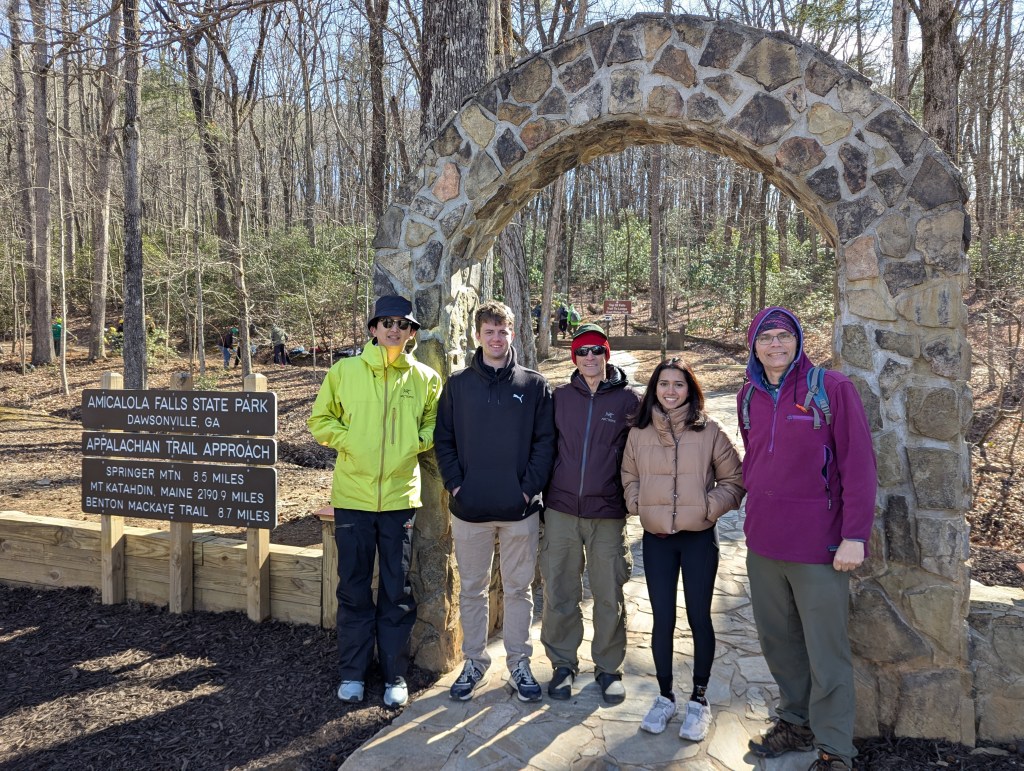
The research team at Amicalola Falls State Park, the unofficial kickoff of the hiking season: Yusheng Cao, Gibbs Gresge, Kris Wernstedt, Jennifer Chandran, Scott McCrickard

Journal paper: Toward a management framework for smart and sustainable resource management

Project co-PI Shalini Misra led a paper that appeared in the Journal of Environmental Management. The paper presented our work in analyzing trail maintainer interviews from 2022, resulting in a framework for smart and sustainable resource management.  The paper sets the stage for understanding how trail maintainers make decisions and get things done. Co-authors include

The work gathers results from our interviews with 18 trail managers, using grounded theory to identify four areas of interest and concern: (1) visitor monitoring and management, (2) information dissemination and two-way communication with hikers; (3) trail monitoring and maintenance; and (4) data analytics for decision-making. For each of these areas, we identified goals, strategies and objectives that were important to the managers, and we posited how digital tools could help in supporting the managers.

Leveraging these findings from the interviews, our framework put forth challenges posed by digital technologies for sustainable resource management grouped into four categories: technological, organizational, ethical, and experiential. For each category, our paper proposes management needs for smart and sustainable resource management.

To learn more about this work, read the full paper at https://www.sciencedirect.com/science/article/pii/S030147972403408X.

As an addendum,

Master’s thesis: Jaitun Patel’s Digital Conservation on the AT

Jaitun Patel came to Virginia Tech without much hiking and outdoor experience, but she jumped right in with OCVT (the Outdoor Club of Virginia Tech) on a spring break trip and subsequent maintenance trips along the Appalachian Trail. She got a hands-on view of what trail maintainers and hikers need, and she parlayed the interest and knowledge into a Master’s thesis–a tool for promoting collaboration and understanding between visitors to trails and the network of people who support those visits.

Jaitun’s research examined the role of information and communication technologies in promoting collaboration between trail agencies (like OCVT, RATC, and other 3-4 letter groups) and the hikers and other visitors that these agencies seek to support. Jaitun conducted social media analysis, interviews, and a design workshop toward crafting and testing a prototype online discussion platform called SmarTrail Board, which “centralized direct communication and streamlined information can support trail management on the AT”. Check out her thesis at http://hdl.handle.net/10919/116284

Jaitun was a big part of our group for two years, helping out with a great many projects and joining us on lots of adventures. Jaitun continues her outdoor research work as a Data Scientist at Washington State University, working with their AgWeatherNet group.

CAPWIC 2023

A Virginia Tech group of 11 students and faculty made the trek from Blacksburg to attend the CAPWIC 2023 conference in Richmond VA. CAPWIC is the Capitol Region Women in Computing conference, an annual regional opportunity to celebrate and promote participation of women and other underrepresented minorities in computing. Virginia Tech had a big presence, featuring 20 students, faculty, and alumni: (1) we were a conference sponsor, hosting a booth for each the Blacksburg and the Capitol Region Innovation Campus; (2) Virginia Tech faculty member and VT Innovation Campus Director Lance Collins presented the opening keynote, connecting “hidden figure” and VT alumna Dr. Gladys West and the new VT Innovation Campus; and (3) we led both a workshop and a panel, detailed here:

Designing Mobile Games for the Outdoors: From Interesting Ideas to Working Games, a workshop on designing games with outdoor themes. Participants learned about ways to design mobile games and how outdoor themes can drive appeal, building on the themes of our Tech on the Trail initiative. The workshop was run by Virginia Tech researchers Scott McCrickard, Morva Saaty, and Jaitun Patel, with 20 students and faculty from 8 colleges and universities engaging in a creative design activity using the Marvel POP sketch-based wireframing tool.

Designing Apps for Diversity: Building Bridges through Mobile and Web App Development, a panel featuring three Virginia Tech alums: Joon Suk Lee, Department Chair of Computer Science at Virginia State University; Chandani Shreshtha, Assistant Professor of Computer Science at James Madison University; and Mohammed Seyam, Collegiate Assistant Professor at Virginia Tech. Scott McCrickard moderated the panel. The panel explored how mobile and web apps can help give voice to individuals from groups that are often marginalized in computer science and other computing fields. Dr. Lee presented his work on microcoordination, delving into to roles of technology in coordinating attention, task completion, and interpersonal interactions. Dr. Shreshtha discussed how the ThoughtSwap tool, developed in her lab when she was a grad student, can be used to support conscientious discourse in classrooms. She talked about how contained anonymity and ephemerality play a role in the swapping of thoughts, toward supporting a broad and diverse set of opinions. Dr. Seyam discussed his experiential learning efforts, with a focus on how synchronous and asynchronous technologies can help facilitate communication.

Below are photos from the event, including of the students, faculty, and alumni who were in attendance.

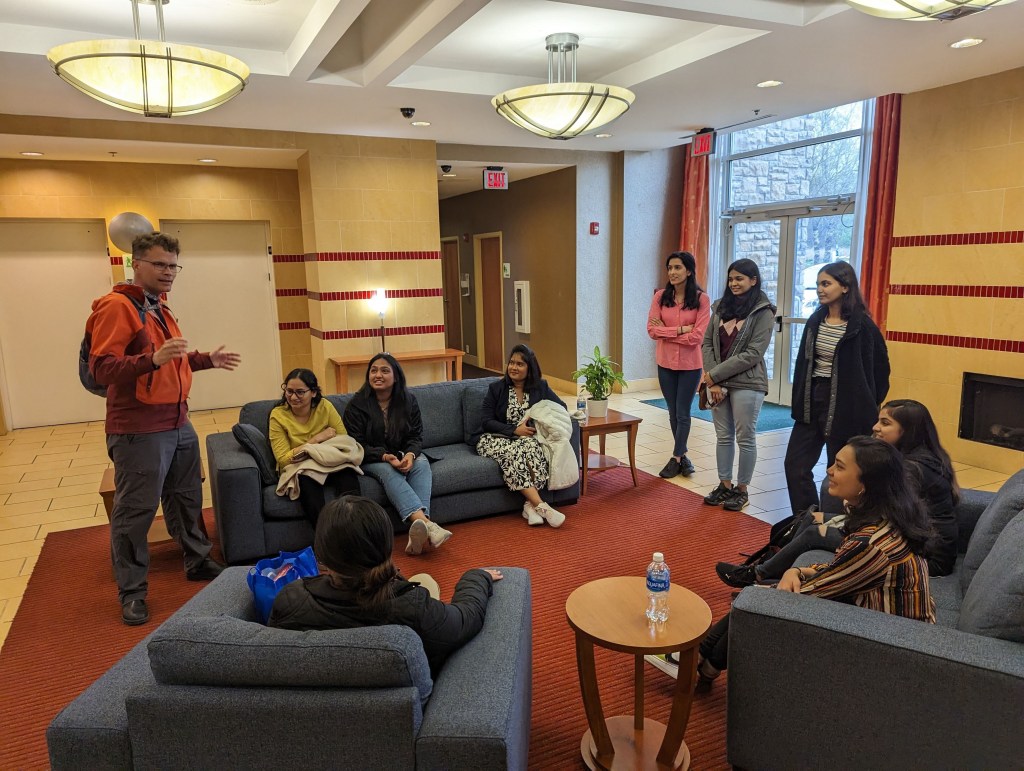
Dr. Scott McCrickard talks to the VT attendees prior to the conference
VT Innovation Campus Director Lance Collins gives the opening keynote
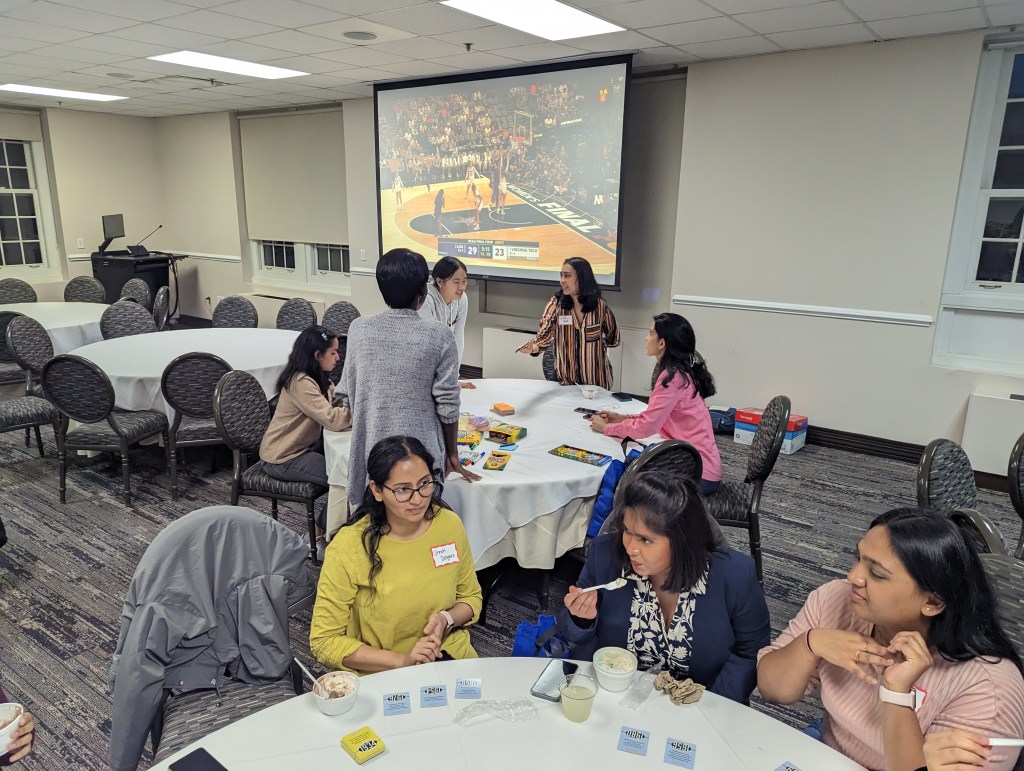
Ice cream and a workshop preview, with the VT women's basketball final four game in the background
Panelists Mohammed Seyam, Chandani Shreshtha, Joon Suk Lee, and moderator Scott McCrickard
Workshop organizer Scott McCrickard kicks off the workshop
Virginia Tech student attendees
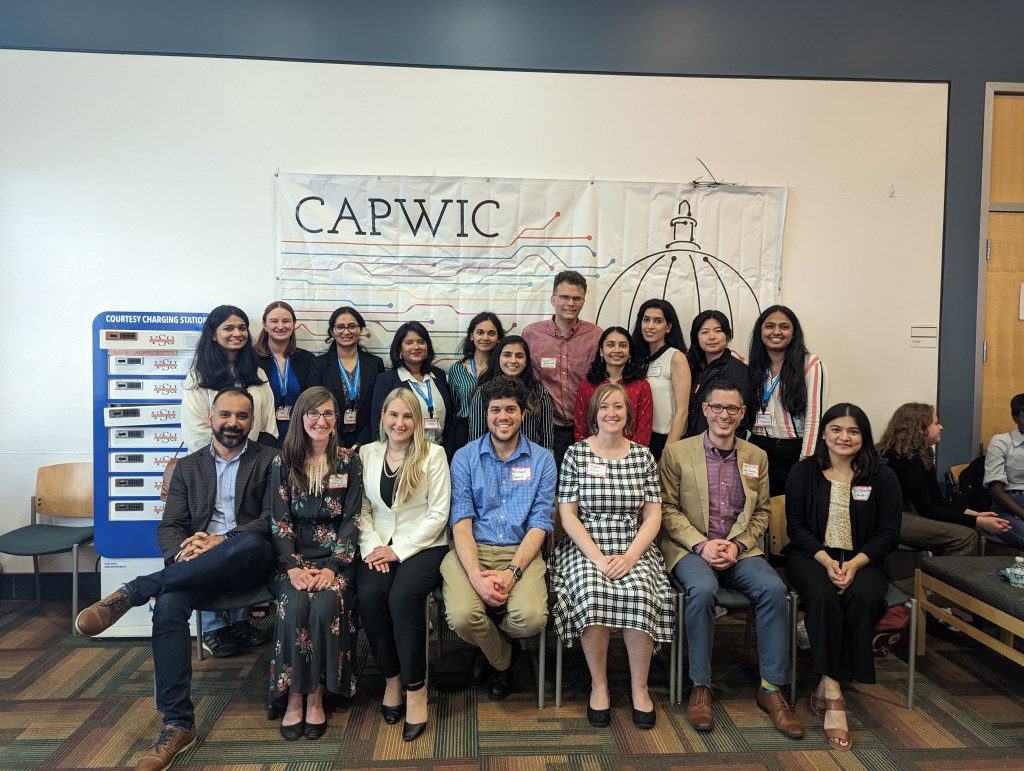
Virginia Tech students, faculty, and alumni at CAPWIC
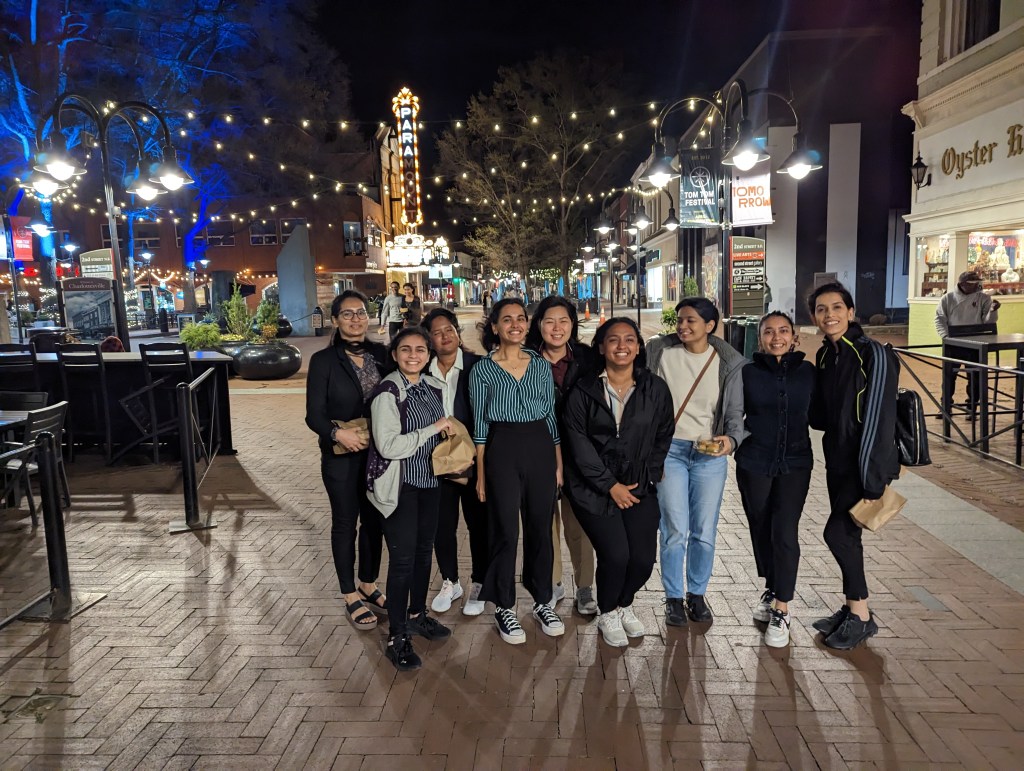
Dinner in Charlottesville on our way back to Blacksburg
Fun in downtown Charlottesville