Emotions about the Appalachian Trail and in Earthships

At the Tech on the Trail lab, we’re always curious about how different people experience nature—and we love a good comparison. Our labmate Morva Saaty recently published a paper at a top HCI conference asking the question, “Is Long-distance Hiking an Emotional Roller Coaster?”. She explored, and continues to research, how Appalachian Trail (AT) hikers express their emotions, especially in relation to weather. In this post, we’re putting her work side-by-side with a blog post by Ian Watson, who took a deep dive into Earthship Biotecture and what it’s like to live off-grid. Both pieces are all about understanding nature lovers—Morva focused on hikers, and Ian focused on Earthship dwellers. Different paths, but similar questions: how does living close to nature shape how we feel?

AT Hiker’s Emotions:

Morva’s study dives into how people express emotions during long-distance hikes—specifically on the Appalachian Trail—by analyzing blog posts from hikers. Morva used emotion recognition tools and topic modeling to figure out what kinds of feelings hikers were sharing and what might be causing them. Unsurprisingly, weather played a big role in shaping those emotions. The takeaway? Emotions are a huge part of the hiking experience, and understanding them better could help build stronger support systems for hikers. Plus, it shows how personal blogs can be a goldmine for understanding real human experiences.

Earthship Owner’s Emotions:

Ian Watson’s informal study is a personal deep dive into Earthships—those off-grid, sustainable homes made from recycled materials. Ian Watson took part in Earthship Academy, helped build Earthships in different countries, and then surveyed people actually living in them. His goal? To understand what it’s really like to live in one. The responses revealed a mix of excitement, challenges, and a strong sense of independence. People loved the self-sufficiency and eco-friendliness, but also faced real struggles with maintenance and community dynamics. Overall, it’s a thoughtful look at what it means to live sustainably—and what it takes emotionally and practically to make that lifestyle work.

Whether it’s through the lens of long-distance hikers or off-grid Earthship dwellers, one thing is clear: people’s emotional experiences with nature are rich, complex, and worth paying attention to. Both Morva Saaty’s research and Ian Watson’s Earthship study show that when we listen closely—especially through personal reflections like blog posts—we gain powerful insights into how humans connect with the natural world. These stories and data points aren’t just interesting; they’re essential for designing better technologies, communities, and support systems that align with how people actually live and feel. As we continue exploring the intersection of tech, emotion, and the outdoors, we’ll keep turning to these digital diaries for guidance.
Appalachian Trail Gateways 2025

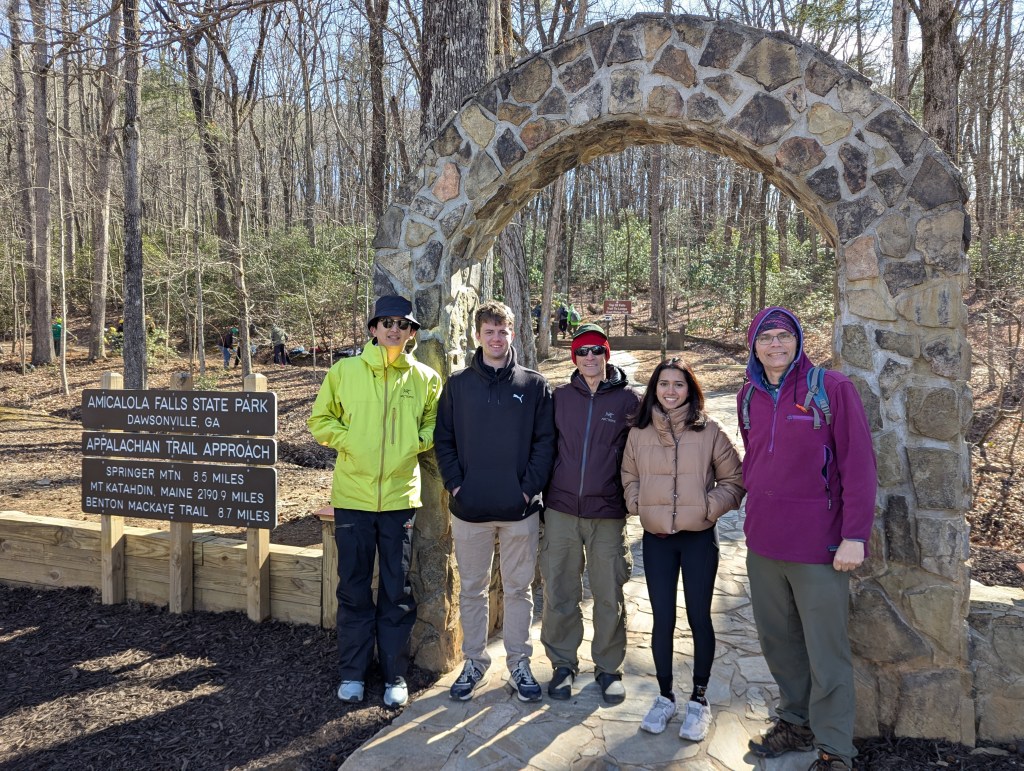
Our NSF project team attended the unofficial kickoff of the hiking season–AT Gateways–from February 28 to March 2 at Amicalola Falls State Park in Georgia. AT Gateways, previously known as the AT Kickoff, includes activities, demonstrations, talks and booths (including ours!), and vendors, mainly at the lodge. At the event, we launched the latest version of our SmartTrail app, a weekly questionnaire for long-distance hikers that helps assess the mental and physical issues that hikers experience.

In attendance from our team were PIs Kris Wernstedt and Scott McCrickard, along with students Yusheng Cao, Jennifer Chandran, and Gibbs Gresge. We divided our recruiting efforts between the main lodge (where most of the festivities occurred) and the visitor center and trailhead arch (where many thru hikers register, get their numbered hiker tag, and start their hike). The trailhead was definitely the best place to recruit–though many of the hikers there were anxious to start their hikes. We recruited about 25 hikers, and we had great conversations with many other current and past hikers.

In addition to launching our app, at the event we presented a talk and hosted a booth that featured findings from our prior research efforts, including our newly released paper led by project co-PI Shalini Misra that summarized our interviews with AT resource managers. There were about 30 people at the talk, and I was struck by the overall positive feedback toward technology use on the trail. This is different than talks even just five years ago–it seems like the presence of technology on the trail is becoming an accepted part of the trail culture (for better and worse).

Overall, it was an impressive event, well attended by people who care deeply about the trail. The park is lovely, and our cabin both had a secluded feel and also felt close to the sights and sounds of the park. We look forward to attending in future years.

The research team at Amicalola Falls State Park, the unofficial kickoff of the hiking season: Yusheng Cao, Gibbs Gresge, Kris Wernstedt, Jennifer Chandran, Scott McCrickard

Master’s thesis: Jaitun Patel’s Digital Conservation on the AT

Jaitun Patel came to Virginia Tech without much hiking and outdoor experience, but she jumped right in with OCVT (the Outdoor Club of Virginia Tech) on a spring break trip and subsequent maintenance trips along the Appalachian Trail. She got a hands-on view of what trail maintainers and hikers need, and she parlayed the interest and knowledge into a Master’s thesis–a tool for promoting collaboration and understanding between visitors to trails and the network of people who support those visits.

Jaitun’s research examined the role of information and communication technologies in promoting collaboration between trail agencies (like OCVT, RATC, and other 3-4 letter groups) and the hikers and other visitors that these agencies seek to support. Jaitun conducted social media analysis, interviews, and a design workshop toward crafting and testing a prototype online discussion platform called SmarTrail Board, which “centralized direct communication and streamlined information can support trail management on the AT”. Check out her thesis at http://hdl.handle.net/10919/116284

Jaitun was a big part of our group for two years, helping out with a great many projects and joining us on lots of adventures. Jaitun continues her outdoor research work as a Data Scientist at Washington State University, working with their AgWeatherNet group.

Student Projects: Appalachian Trail Counties and Cities in Southwest Virginia

We received a heads-up about a relevant class here at VT that will be displaying their final projects in a public event on Monday, April 24th in VT’s Newman Library Multi-purpose Room. Here’s the blurb about the projects and their website. Scott and Gracie are planning on going, and hopefully our own TotT class will be interested as well.

I’m a historian at VT, teaching a course, Introduction to Data in Social Context, which encourages to think critically and creatively about the ways that data analysis can inform understanding of contemporary issues (and vice versa). For their final projects, the twelve students in the class will be examining data about the twenty or so cities and counties close to the Appalachian trail between the NC / TN border and just north of Roanoke. The students have identified themes that they will be researching in the next couple of weeks. Their projects will be displayed in Newman library on Monday, April 24, from 10-11 am in the Multipurpose Room. Given your interest in technology along the trail, I hope that you might also be interested in their research on the communities along the trail. Please forward this invitation to your colleagues involved in this project, or to others who might be interested. The schedule will be posted (and updated) at the website linked below.

Appalachian Trail Cities and Counties in Southwest Virginia: http://ethomasewing.org/at_virginia/