Emotions about the Appalachian Trail and in Earthships

At the Tech on the Trail lab, we’re always curious about how different people experience nature—and we love a good comparison. Our labmate Morva Saaty recently published a paper at a top HCI conference asking the question, “Is Long-distance Hiking an Emotional Roller Coaster?”. She explored, and continues to research, how Appalachian Trail (AT) hikers express their emotions, especially in relation to weather. In this post, we’re putting her work side-by-side with a blog post by Ian Watson, who took a deep dive into Earthship Biotecture and what it’s like to live off-grid. Both pieces are all about understanding nature lovers—Morva focused on hikers, and Ian focused on Earthship dwellers. Different paths, but similar questions: how does living close to nature shape how we feel?

AT Hiker’s Emotions:

Morva’s study dives into how people express emotions during long-distance hikes—specifically on the Appalachian Trail—by analyzing blog posts from hikers. Morva used emotion recognition tools and topic modeling to figure out what kinds of feelings hikers were sharing and what might be causing them. Unsurprisingly, weather played a big role in shaping those emotions. The takeaway? Emotions are a huge part of the hiking experience, and understanding them better could help build stronger support systems for hikers. Plus, it shows how personal blogs can be a goldmine for understanding real human experiences.

Earthship Owner’s Emotions:

Ian Watson’s informal study is a personal deep dive into Earthships—those off-grid, sustainable homes made from recycled materials. Ian Watson took part in Earthship Academy, helped build Earthships in different countries, and then surveyed people actually living in them. His goal? To understand what it’s really like to live in one. The responses revealed a mix of excitement, challenges, and a strong sense of independence. People loved the self-sufficiency and eco-friendliness, but also faced real struggles with maintenance and community dynamics. Overall, it’s a thoughtful look at what it means to live sustainably—and what it takes emotionally and practically to make that lifestyle work.

Whether it’s through the lens of long-distance hikers or off-grid Earthship dwellers, one thing is clear: people’s emotional experiences with nature are rich, complex, and worth paying attention to. Both Morva Saaty’s research and Ian Watson’s Earthship study show that when we listen closely—especially through personal reflections like blog posts—we gain powerful insights into how humans connect with the natural world. These stories and data points aren’t just interesting; they’re essential for designing better technologies, communities, and support systems that align with how people actually live and feel. As we continue exploring the intersection of tech, emotion, and the outdoors, we’ll keep turning to these digital diaries for guidance.

Walking Into Herself: Mattie’s Camino Pilgrimage

We recently interviewed Mattie Andersen! Mattie is a computer scientist whose work has explored the intersection of people, technology, and the environments they inhabit. While her resume speaks for itself, what makes Mattie’s perspective especially compelling is that she’s not just a researcher—she’s also a pilgrim.

Mattie Andersen, ready for her pilgrimage on the Camino trail, smiles confidently while hiking in the mountains.

The Allure of the Camino

In 2022, Mattie’s older brother, Hayden, set out on a five week long-distance pilgrimage covering the main route of the Camino trail. She never quite figured out how he discovered the trail, but was inspired by her interactions with him. While he was on the trail, she connected with him over phone calls and messages. Two years later Mattie decided to complete a pilgrimage of her own.

In the two years preceding her pilgrimage, Mattie became interested in physicality and deepening her relationship with her body. She had never completed a long distance hike. She had never had to navigate Spain alone as a single woman traveler. Yet, the Camino called. 

Getting Ready for the Camino

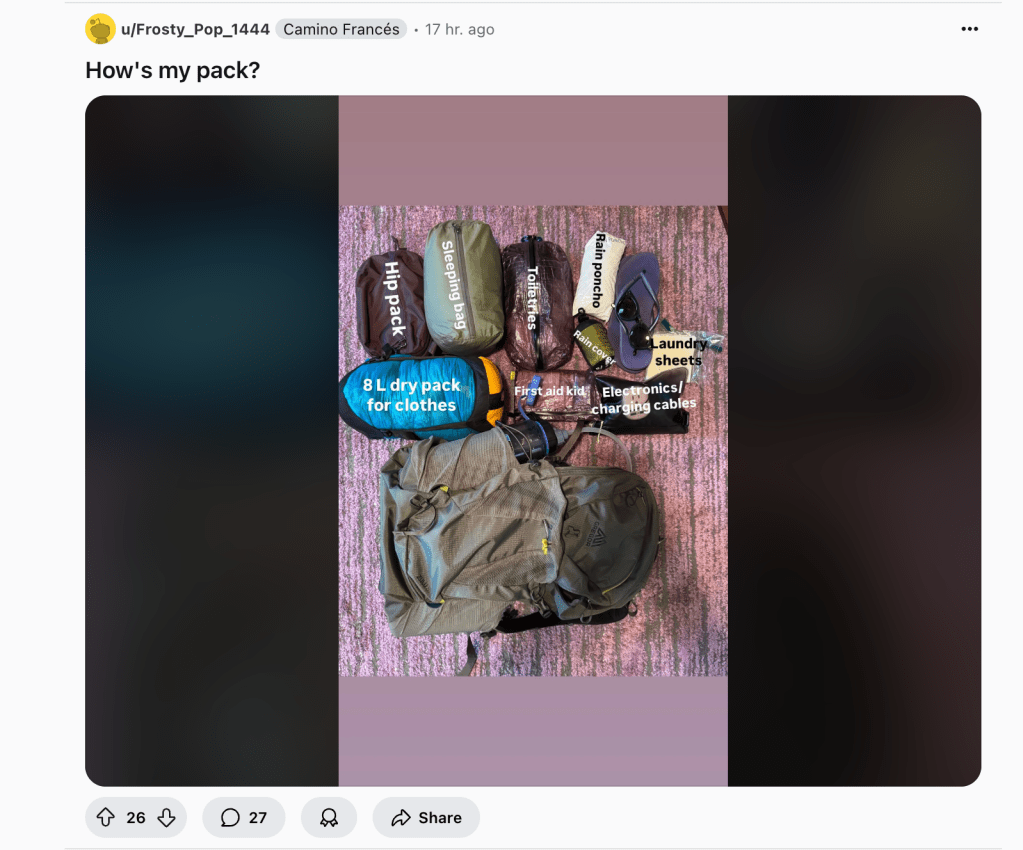
As Mattie prepared for the Camino, she developed a new relationship with her body, in terms of fitness. She became curious about what it would take to carry her body across the hundred+ mile pilgrimage finish line. Hayden’s hike might’ve prompted Mattie’s interest but as she prepared, the Camino began to take on a life of its own. On the weekends, Mattie undertook 13 mile day hikes toning her muscles, and mentally preparing to walk everyday, all day. In addition to her physical preparation, Mattie had to pack. She relied on the Camino trail subreddit to refine her packing list:

“[Reddit] is a very popular place for people to post a picture of everything they are bringing and ask, ‘Can you tell me what I need or should take out?’”

A detailed packing list for a long-distance hike, showcasing essential items for the Camino pilgrimage.

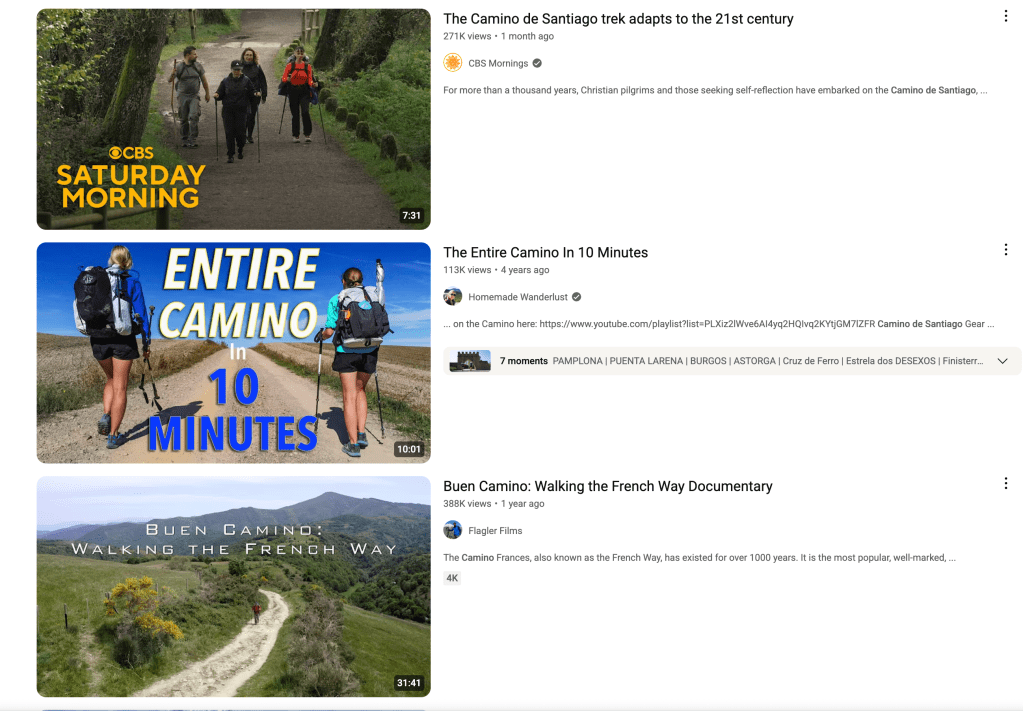
Mattie is unique among the hikers that we have interviewed because she didn’t watch Camino trail YouTube videos before her hike. Mattie didn’t want to spoil the physical trail for her and wanted to land in Spain with no idea of what the road ahead looked like. Youtube Camino trail videos are a popular sub genre on the platform.

Camino trail Youtube videos blend the hiking, tourism, and story telling online communities.

On the Trail

Mattie was expecting her Camino to be a spiritually taxing, introspective experience. However, the Camino for Mattie was a joyful, living in the moment experience where she left the cares of her “regular world” behind. She loved the trail and the people she met along the way. Her days were structured around staying close to her “pilgrim pod” similar to an Appalachian Trail “tramily”. WhatsApp was the main communication tool on the trail and this is how Mattie kept in touch with her pod and reserved hostel rooms.

Digital communication on the trail, like WhatsApp and Booking.com, is a relatively new phenomenon and has been met with some resistance. There are Camino “purists” who believe that a pilgrimage should be completed without the aid of a smart phone. Mattie does not align with this ideology. She didn’t think that her phone use distracted from her experience. If anything, it helped her not be limited by lowering her anxiety and overcoming the language barrier. With tools like Booking.com, Duolingo, and WhatsApp she was able to communicate with the folks along the trail. Another way that Mattie used her phone on the trail was recording her experience. Not one to share on social media, Mattie stuck with pictures and videos to preserve her experience:

” I think my favorite videos are the ones where I’m with people and I’m filming and I can hear their chatter in the background.”

The Camino trail has seen thousands of visitors. As more pilgrims begin to use their phones, the Camino trail hostel owners and shops have had to adapt. Mattie saw older hostel owners adapting in different ways. For example, they would take down the information she provided online and jot in down in their physical account books. Others used various apps to take pictures of passports and register pilgrims. We make special note of this because it shows the ingenuity of older adult business owners along the Camino trail and defies ageist technology stereotypes.

Business owners are not the only people adapting to a digital trail culture. Pilgrims are now able to share their experience with family members and friends in real time. Mattie is a special case compared to other long distance hikers because communicated with her family only to let them know that she is alive and well. Mattie is not alone in enjoying limited digital interaction, some hikers go to the trail to get away from the modern world. However there is a large group of hikers that video, photograph, and call their way along the trail. Mattie wanted to live in the moment and share an abbreviated version of her travels when she gets home.

We want to thank Mattie for her time and insights. She is an inspiring example of setting a goal and accomplishing it in an individualized way. We wish her safe travels on future trips and look forward to hearing more stories about the trail.

Hot Springs TrailFest 2025

PIs Kris Wernstedt and Scott McCrickard, along with graduate students Yusheng Cao and Wei-Lu Wang, attended TrailFest 2025 in Hot Springs NC to launch our new SmartTrail mobile app to thru hikers. Supported by our NSF SAI grant, the app surveys hikers every week for up to 14 weeks during their thru hike of the Appalachian Trail. The survey probes their technology use, their connectivity with others, and their changing tolerances for risk throughout their hike.

There’s a great AirBnB, the Dorland Cottage on Bridge Street, right along the Appalachian Trail as it passes through downtown. We set up there with beverages, snacks (freshly made chocolate chip cookies and fruit!), and a place to sit and watch the world go by. We distributed the latest version of our SmartTrail app (and lots of snacks!) to thru-hikers who were interested, and encouraged everyone to stop and rest for a while even if they were not interested. We were pleased to recruit 50 hikers to consider using our app, and we caught up with many more who are looking to keep their digital burdens low while on the trail.

In addition, we hosted a booth in the festival area. We were able to talk with festival attendees about results from our prior surveys, interviews, observations, and social media and blog analysis. Best of all, we got to enjoy the live music, 40+ booths, and festival food while we were there. The long weekend was capped off with a trip to Big Pillow Brewing and Grey Eagle Taqueria, which have re-opened in the downtown area. As always, the area was filled with a lively mix of hikers and locals.

The festival was cancelled last year due to hurricane damage, and there remains significant damage to the downtown area. This weekend was billed as we were happy to return this year and support the local community. We weren’t able to hike any of the local trails on this trip, but we encourage anyone who loves the outdoors and the Appalachian Mountains to plan a trip to Hot Springs. They are ready for you!

Researchers and hikers engage in discussions about the new SmartTrail app at TrailFest 2025 in Hot Springs, NC. The Dorland Cottage is a great place to recruit: right across Walnut Street runs the Appalachian Trail, with Bluff Mountain Outfitters visible in the distance and Dollar General behind us.

Appalachian Trail Gateways 2025

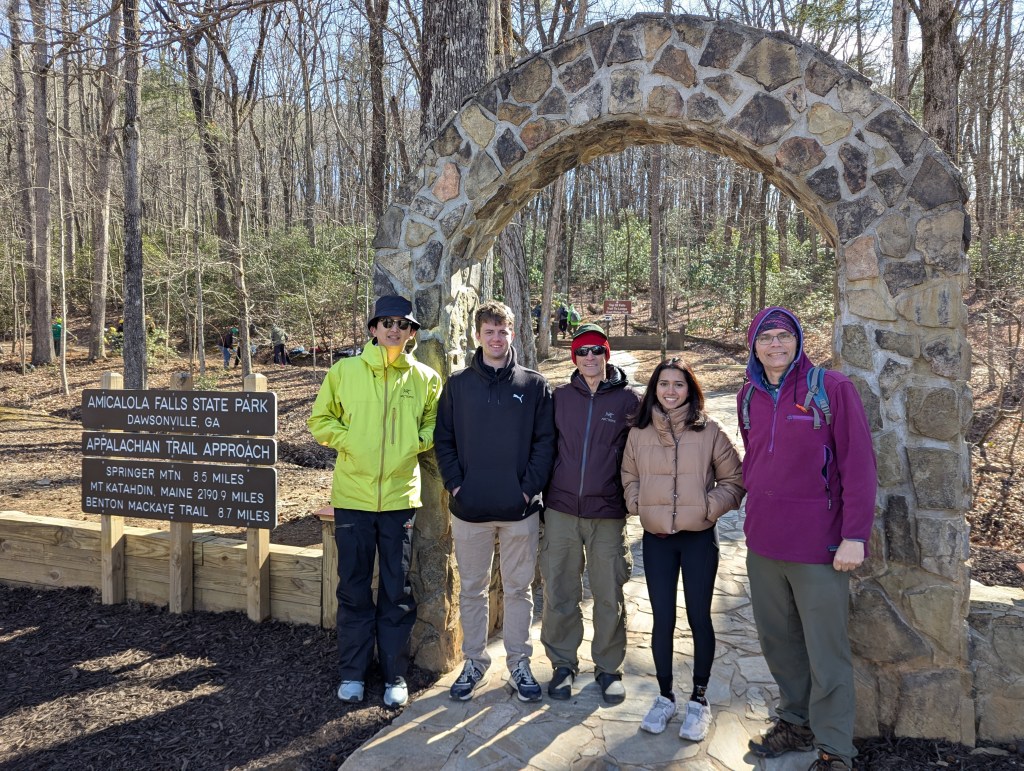
Our NSF project team attended the unofficial kickoff of the hiking season–AT Gateways–from February 28 to March 2 at Amicalola Falls State Park in Georgia. AT Gateways, previously known as the AT Kickoff, includes activities, demonstrations, talks and booths (including ours!), and vendors, mainly at the lodge. At the event, we launched the latest version of our SmartTrail app, a weekly questionnaire for long-distance hikers that helps assess the mental and physical issues that hikers experience.

In attendance from our team were PIs Kris Wernstedt and Scott McCrickard, along with students Yusheng Cao, Jennifer Chandran, and Gibbs Gresge. We divided our recruiting efforts between the main lodge (where most of the festivities occurred) and the visitor center and trailhead arch (where many thru hikers register, get their numbered hiker tag, and start their hike). The trailhead was definitely the best place to recruit–though many of the hikers there were anxious to start their hikes. We recruited about 25 hikers, and we had great conversations with many other current and past hikers.

In addition to launching our app, at the event we presented a talk and hosted a booth that featured findings from our prior research efforts, including our newly released paper led by project co-PI Shalini Misra that summarized our interviews with AT resource managers. There were about 30 people at the talk, and I was struck by the overall positive feedback toward technology use on the trail. This is different than talks even just five years ago–it seems like the presence of technology on the trail is becoming an accepted part of the trail culture (for better and worse).

Overall, it was an impressive event, well attended by people who care deeply about the trail. The park is lovely, and our cabin both had a secluded feel and also felt close to the sights and sounds of the park. We look forward to attending in future years.

The research team at Amicalola Falls State Park, the unofficial kickoff of the hiking season: Yusheng Cao, Gibbs Gresge, Kris Wernstedt, Jennifer Chandran, Scott McCrickard