Designing Outdoor Games

I’m pleased to announce that our research on mobile apps for supporting outdoor activities was funded by Virginia Tech’s Institute for Critical Technology and Applied Science (ICTAS). More to come, but here’s a description of the multi-university project:

This proposal assembles researchers with interests in education, gaming, science, art, history, and technology to explore and design educational games for outdoor settings. The proposed efforts will result in scientifically-grounded games focused on learning. The proposal addresses the ICTAS RFP by bringing together faculty at VT and HBCUs in an area likely to result in funding proposals. This proposal is related to the ICAT theme “Reimagining Education” by creating new educational games at the intersection of science, art, history, and technology.

The VT-HBCU team combines researchers and practitioners at Virginia Tech with those at two Virginia HBCUs: Norfolk State University (NSU) and Virginia State University (VSU). The three locations reflect differences in Virginia’s cultural, historical, environmental, and diversity aspects. VT PI McCrickard leads the Technology of the Trail initiative, exploring ways that technology enhances the outdoor experience, and he has led prior diversity-related initiatives with the partner HBCUs. Co-PI Morsi (NSU) has presented at GamiCon, the Frontiers in Education conference, and other top venues that reflect her expertise in research at the intersection of gaming and education. She will give lectures about necessary design elements to be included in successful educational games, and she will recruit and advise students to work on projects. Co-PIs Doswell (NSU) and McCrickard (VT) have worked together on prior Broadening Participation in Computing efforts, with external funding and publication success.  Co-PI Lee (VSU), a VT graduate, VSU department head, and CHILD Lab director, will sponsor projects in VSU’s new app development courses. The faculty are committed to pursuing government and corporate funding opportunities based on findings from the projects.

The proposed work will connect faculty and will identify students (both grad and undergrad) with interest in developing mobile games and educational software to help raise awareness of science, history, art, and the environment. Potential topics include: games for identification of plants; diversity-related historic trail walks; exercise games built on Fitbit data; and sharing trail experiences through photographs and videos. Games will be client-based, ensuring strong connections to science, history, and technology. Projects will be scoped by at least one PI and at least one client. Each possible client has worked with one or more of the PIs on similar projects in the past. We will actively recruit other clients from science, history, and art.
COMPASS 2022 paper: Reddit and the AT

Grad student Morva Saaty took the lead on a note published and presented at the COMPASS 2022 conference titled “Studying Sustainable Practices of Appalachian Trail Community based on Reddit Topic Modeling Analysis. Co-authors include Jaitun Patel, Norhan Abdelgawad, Jeff Marion, Scott McCrickard, Shalini Misra, and Kris Wernstedt. Morva and Jaitun represented Virginia Tech at the conference at the University of Washington in Seattle.

The note examined how the social media platform Reddit helps people prepare for the experience of hiking the Appalachian Trail. A key focal point of our investigation was to see what topics were most frequently discussed, and whether issues of sustainability and “leave no trace” (LNT) were major topics of discussion. Certainly the first LNT principle, “plan ahead and prepare”, is a major topic of discussion. There was a lot of discussion about the right ways to care for the shelters and campsites, including LNT-related topics. But LNT as a topic itself rarely was raised, at least not by name. Our note concludes by issuing a challenge for social media researchers to understand Reddit in two regards: information and communication interventions, and understanding hikers’ experiences.

The ACM Conference on Computing and Sustainable Societies (COMPASS) is a fairly new conference in the ACM lineup, starting in 2018. It focuses on research that addresses challenges of underrepresented and marginalized communities, including conservation, climate change, accessibility, equity, and education, among others. The conference seeks to include researchers and practitioners from both academia and industry, with a variety of research areas covered, including human-computer interaction, artificial intelligence, networking, communication, government and public affairs, health and wellness, and many others. It seems to be a growing conference, one to consider for future submissions related to the tech on the trail initiative.

BOOK RELEASE PART 2: HCI Outdoors: Theory, Design, Methods and Applications

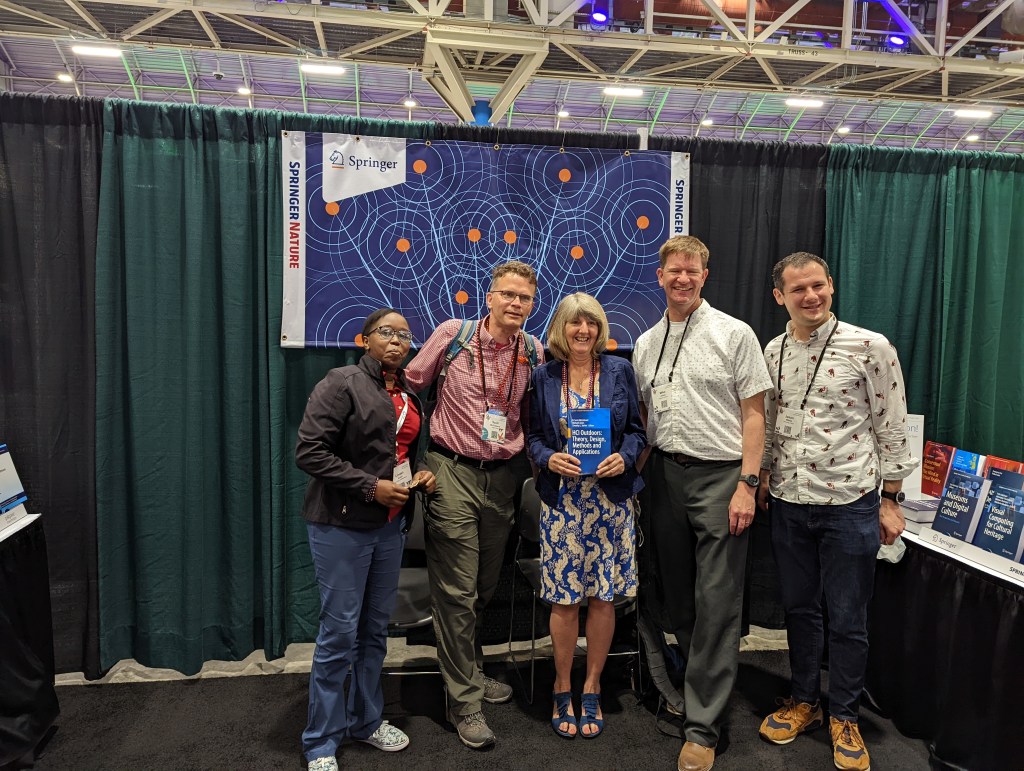
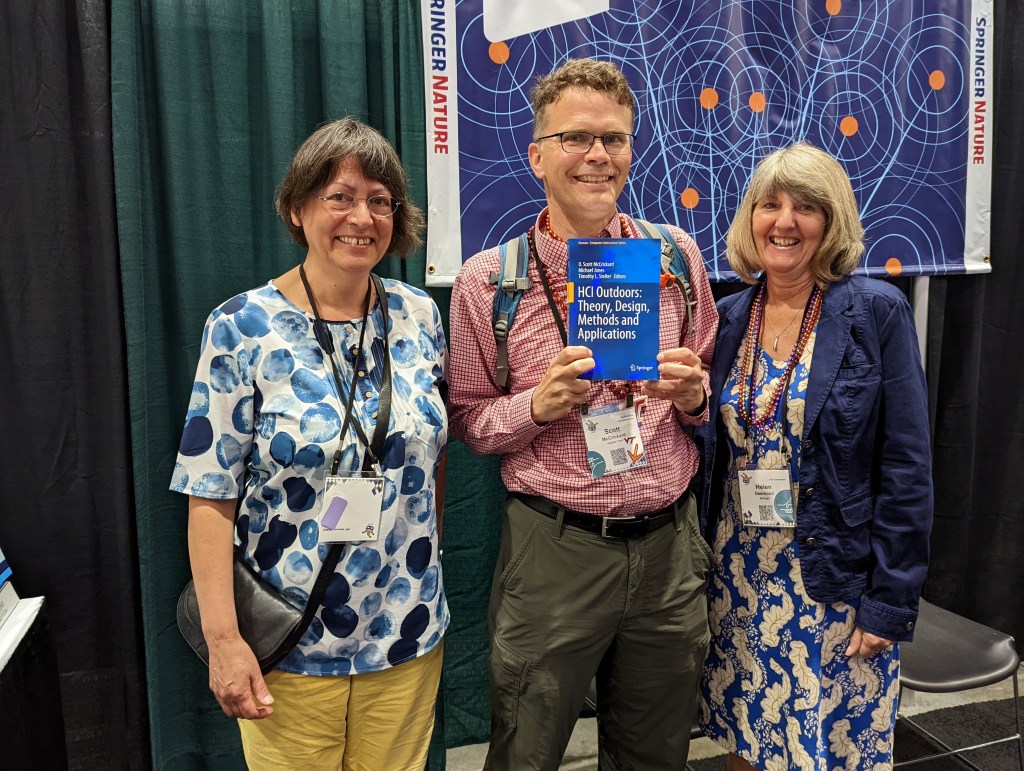
Our book received its first public unveiling at this year’s ACM SIGCHI Conference in May 2022.  HCI Outdoors: Theory, Design, Methods and Applications, from Springer Publishing, is an edited volume of contributions from 18 groups of authors in academia, industry, research labs, and think tanks who are defining new ways that technology is explored, designed, and tested for use in outdoor settings. The book consists of five sections: Rural Contexts, Willed and the Wild, Groups and Communities, Design for Outdoors, and Outdoor Recreation.

I provided a full description of the book in a previous post upon the release of the book. The SIGCHI event served as an opportunity for chapter authors to gather with the publisher and talk to interested readers. Despite an absence of many authors who had Covid concerns and other conflicts, six authors and editors were able to stop by the booth, and there was lots of interest from conference attendees.

My co-editor Mike Jones and I are brainstorming future ideas for the HCI Outdoors efforts–maybe a follow-up workshop at a future SIGCHI or another conference, partnership with companies that produce and distribute outdoor-related technologies and apps, and grants and publications with other academics and researchers. Please contact us if you’re interested in joining us in these efforts!

Reading reflection: Sylvain Tesson’s Consolations of the Forest

I went to spend six months in a Siberian cabin on the shores of Lake Baikal, on the tip of North Cedar Cape.

Consolations of the Forest: Alone in a Cabin in the Middle Tiaga

Sylvain Tesson is a geographer by training and a journalist by occupation, but most of all he’s an adventurer. He’s bicycled around the world, descended into caves in Borneo, crossed the Himalayas on foot, and ridden by horseback across the Central Asian steppes. But the ultimate test of his physical and mental abilities, and the subject of this book, was to live for 6 months in withdrawal from society in a tiny cabin in Siberia. The book reads like an annotated diary, packed with reflections of his thoughts during isolation, the many books he read, the copious vodka he imbibed, his visits with neighbors (who were many hours away from him), and interactions with the world around him.

Tesson attempted to bring digital technology on his adventure, including multiple electronic devices and the rechargeable batteries, solar panels, and cables to keep it working. But what he couldn’t control was the temperature, which often dipped well into the negatives—not a good environment for technology. His computer and satellite phone both failed, though later in his trip his phone miraculously started working again, allowing him to check the weather and touch base with the outside world in a minimal way.

But virtually none of his stories centered on the electronics, failed or otherwise. He wrote his thoughts out by hand in a notebook, and maintained some level of sanity by establishing a routine that was both simple and challenging. It’s a way of living that’s most of us only experience in some small way, like when our computer dies and our phone can’t find a signal. Sometimes we embrace it by going out into the wilderness, though even those opportunities are becoming harder to find, like the trail or campsite that lacked internet on the last visit five years ago now has coverage and is filled with people binging their favorite new Netflix show.

Many a hiker have lamented the loss of wilderness to technology. My favorite Bill Bryson quote from A Walk in the Woods is “How I hate all of this technology on the trail”. And when Wild author Cheryl Strayed visited Virginia Tech, she agreed that her walk of the Pacific Crest Trail would have been very different in the current era of ubiquitous mobile coverage. Maybe Tesson will be next, when technology takes over Siberia.