Reading Reflection: Tim Kaine’s Walk Ride Paddle

What an awesome birthday–to celebrate, Lisa took me to hear Senator Tim Kaine talk at the Taubman Museum in Roanoke about his new book, Walk Ride Paddle: A Life Outside. As he approached his 60th birthday, Senator Kaine sought to accomplish his own version of the Virginia triple crown by hiking all of the Appalachian Trail miles in Virginia, biking all of the Blue Ridge and Shenandoah Parkways in Virginia, and paddling the length of the James River in Virginia. He did this over several years, during long weekends and breaks from his Senate duties. He journaled about this journey, and assembled these pieces into a book.

I’ve read all of the hiking portion of his book. He mixes stories about the trials and tribulations on the trail with stories about life, family, and his time in politics. I’ve read a lot of thru hiker books but not as many by section hikers like Tim Kaine–it’s a different type of planning and experience trying to squeeze in hikes with life responsibilities rather than set things aside for 4-5 months. Senator Kaine appreciates the disconnection from the world that hiking provides, though he acknowledges he missed a great picture of a bear encounter because his phone was turned off and in his pack! I’d be remiss if I didn’t share a quote about his technology use and (dis)connection from the outside world:

I carry an iPhone with my Guthook trail app installed. I also carry a small solar-chargeable battery. But I keep the phone off during the day, stashed in a small dry bag in my backpack. I use the phone sparingly to save the battery. If I see a great view, I turn on the phone and take a picture. If I feel like I am lost or not sure how long it is until the next water source or overnight stop I turn the phone on and check the trail app. Maybe twice a day, when I get reception, I turn the phone on and send a message to Anne and my staff, letting them know where I am and maybe forwarding a picture. I will check emails once a day just to see if there is any emergency needing my attention–staff knows to keep emails to pressing priorities while I am hiking. Finally, I type a few trail notes at the end of the day about the miles I have covered and any events of note. All told, the iPhone may be on about thirty minutes a day.

I was able to talk to Senator Kaine after his talk and was able to share a bit about my trail research. He acknowledges the pull that technology has and takes steps to avoid it, though he relies on digital maps (over paper maps) and takes advantage of the ability to connect with others while on the trail.
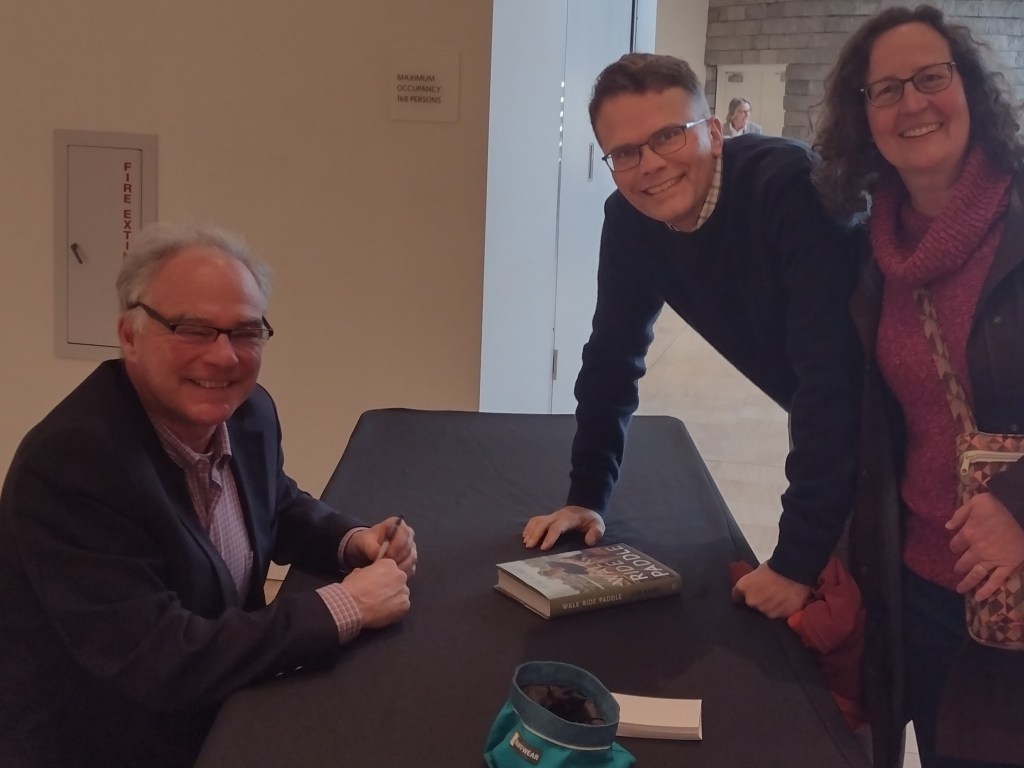

Lisa and I got to engage with Senator Tim Kaine during a book signing event for ‘Walk Ride Paddle: A Life Outside’ at the Taubman Museum in Roanoke.

BOOK RELEASE PART 2: HCI Outdoors: Theory, Design, Methods and Applications

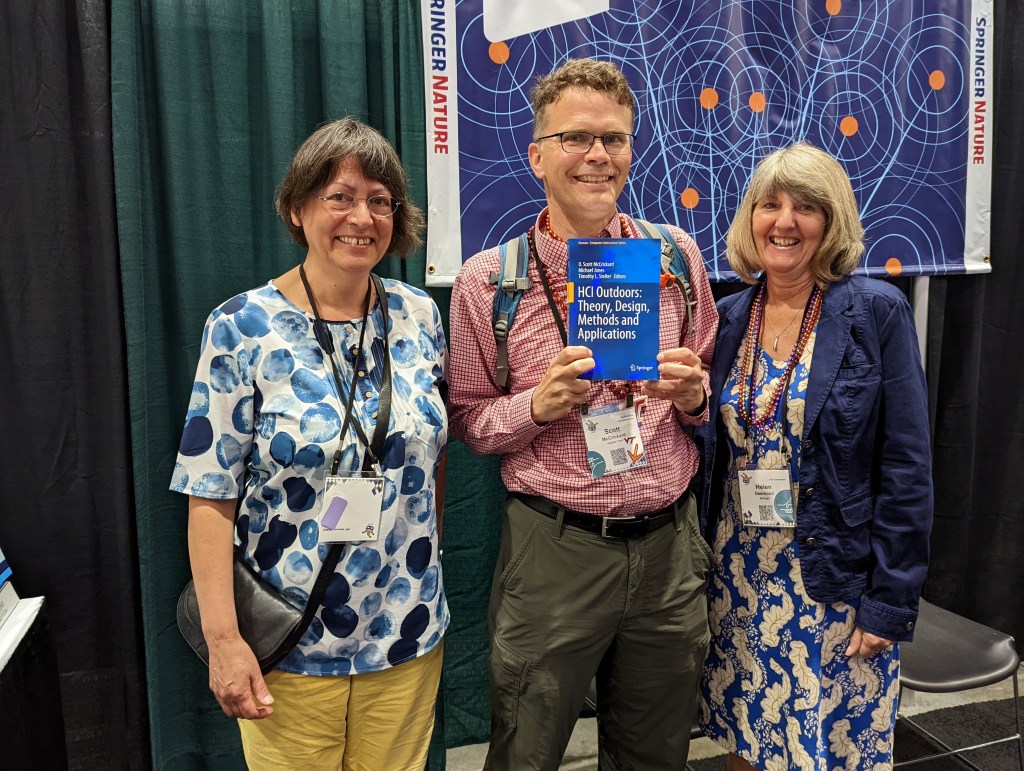
Our book received its first public unveiling at this year’s ACM SIGCHI Conference in May 2022.  HCI Outdoors: Theory, Design, Methods and Applications, from Springer Publishing, is an edited volume of contributions from 18 groups of authors in academia, industry, research labs, and think tanks who are defining new ways that technology is explored, designed, and tested for use in outdoor settings. The book consists of five sections: Rural Contexts, Willed and the Wild, Groups and Communities, Design for Outdoors, and Outdoor Recreation.

I provided a full description of the book in a previous post upon the release of the book. The SIGCHI event served as an opportunity for chapter authors to gather with the publisher and talk to interested readers. Despite an absence of many authors who had Covid concerns and other conflicts, six authors and editors were able to stop by the booth, and there was lots of interest from conference attendees.

My co-editor Mike Jones and I are brainstorming future ideas for the HCI Outdoors efforts–maybe a follow-up workshop at a future SIGCHI or another conference, partnership with companies that produce and distribute outdoor-related technologies and apps, and grants and publications with other academics and researchers. Please contact us if you’re interested in joining us in these efforts!

Reading reflection: Philip D’Anieri’s The Appalachian Trail: A Biography

What does it take to craft a new book about an old trail? Philip D’Anieri chose to focus on the people who shaped the Appalachian Trail, shining a spotlight on one or two from each era of the trail. His book, The Appalachian Trail: A Biography, consists of a series of biographies that trace the evolution of the Appalachian Trail (AT) from a dream to a reality. The choice to craft a biography-centric view of the AT was both unique and appropriate–each chapter captures the unique skills and approaches of each individual, reflecting the balance between solitude and individualism with importance of community on the AT. As a collection, the book demonstrates how each person’s vision, matched with their unique talents and foibles, helped mold the AT into what it is today. Rather than focusing primarily on the role of technology in understanding trail use on the trail perspective,

Philip D’Anieri is a lecturer in architecture and regional planning at the University of Michigan. He admits that he’s not much of a hiker, and an outsider to the AT community, so it seems like an odd choice for him to focus on a hiking trail that stretches over 2000 miles through the Appalachian mountains. His introductory chapter includes a description of his own section hike of a small portion of the trail, on which he “failed to summit a mountain of utterly mediocre stature”. It became increasingly clear to him that he hadn’t prepared well–he didn’t understand how challenging the climb would be, he started late in the day with the possibility of ending in the dark, and, perhaps most egregiously, he failed to bring any water. He redefined victory, embracing his “up and down” experience to that moment and eschewing the dangers of extending it, as he cut short his hike and returned to his car.

So it might be comforting to know that D’Anieri doesn’t approach his storytelling from the perspective of an expert hiker, but as an expert in urban and regional planning. His teaching and research has explored how urban areas evolve through intentional decisions and uncontrolled events, and he turns that lens to seek to understand the AT. He chooses to focus on select individuals who were instrumental in the evolution of the AT, acknowledging that, in so doing, he walks the line between oversimplifying the evolution of the AT and understating the rich lives of the people who are profiled in an effort to highlight the symbiosis between the evolution of the AT and the lives of the people who were part of the evolution. His exploration includes the original mapping of what would become the AT by Arnold Guyot, the vision for a trail from Benton MacKay contrasted with the reality organized and executed by Myron Avery, the early thru-hiker tales spun by Earl Shaffer and Emma “Grandma” Gatewood, and the telling of the trail by gifted storyteller Bill Bryson. He provides pointers to additional readings about the AT and about many of the featured individuals for the interested reader.

D’Anieri also summarizes the ways that technology has influenced the AT experience. He details three changes that have come about because of technology: (1) “how quickly and easily trail knowledge moves around” including through maps, progress updates, and pre-trip research; (2) social media and the “public performance” aspects of a hike, in which you endeavor to develop and promote a personal brand (which should include the many blogs that emerge each year); and (3) the “blurring of dividing line between civilization and nature” which leads to everything from doing business to contacting Mom becoming an obligation that is difficult to escape–people know you are in contact and expect prompt responses to their queries and entreats!

If you want to read more about the book, check out the official book site, an interview in Discover magazine, or a University of Michigan article. Or, if you haven’t already, go read the book!

Reading reflection: The Oregon Trail: A New American Journey

There are tons of “American journey” stories out there, and authors can struggle to find an interesting angle toward authoring a book or blog or such. Rinker Buck certainly can’t be called uninteresting in his choice of adventure: re-creating the Oregon Trail in modern times using the same style of ox-drawn covered wagon employed by the settlers.

Rinker Buck’s book The Oregon Trail: A New American Journey chronicles his journey along the Oregon Trail, a gateway across America taken by settlers in the early 1800s.  The book notes that the notion of a single “Oregon Trail” is deceptive, as there are many paths that were used by settlers making the journey west. Parts of the trail have become roads and highways and some goes through private property, but much of it is far from civilization, so the author had to choose a path that was safe, legal, and enjoyable.  The book balances stories about traveling through wilderness and traveling on modern roads in an old-style vehicle, interleaving the history of the trail and observations about the people that he met along the way.

As always, I kept an eye toward tech use, which was not at all a focus of the book.  The author had a mobile phone on his journey that he occasionally used, but generally he relied on the oft-present kindness of people that he encountered along his journey.  He certainly had a lot to say about the role of technology in enabling trail travel, then in making it obsolete–focusing on tech advances in transportation, manufacturing, and farming. In reading between the lines, the author seemed to intentionally avoid writing about personal technology use, seeking to add to the air of authenticity regarding their journey.

Overall, the book was entertaining and very well written, certainly worth a read both for the historical perspectives and to learn about a meaningful trip across America.